Vending finance
Vending machine payback period: how long until a machine pays for itself
Payback period answers the question most new operators ask first: how long until this machine has earned back what it cost? It is simple to calculate, easy to explain to a lender or partner, and a useful check on whether a site is worth the risk.
What is payback period?
The payback period is the time it takes for the cumulative profit from an investment to equal the amount invested. For a vending machine it is the total upfront cost divided by the average monthly net contribution.
Last reviewed 19 October 2026
The payback formula
Payback period (months) = total upfront investment ÷ average monthly net contribution. Upfront investment includes the machine, card reader, installation and opening stock. Monthly net contribution is sales minus stock, card fees, servicing, insurance and repairs reserve.
If the machine is financed, use the contribution before loan repayments to measure the machine's own payback, then check separately that the repayments are affordable each month.
Worked examples at three site sizes
Based on our own machines averaging $4.40 per vend, for a $7,500 all-in investment. Costs use the same assumptions as the ROI example.
| Weekly vends | Weekly sales | Monthly contribution | Payback |
|---|---|---|---|
| 50 vends (quieter site) | $220 | about $273 | around 27 months |
| 65 vends (typical site) | $286 | about $407 | around 18 months |
| 80 vends (busy site) | $352 | about $541 | around 14 months |
What shortens payback
Higher sales are the biggest lever, and they come from headcount, long shifts and a lack of nearby alternatives. Industrial estates without cafés, regional mine-support yards and large distribution centres often pay back fastest for exactly that reason.
Lower investment also helps. A well-maintained refurbished machine can cut the upfront cost substantially, and buying several machines at once may earn a discount. Efficient rounds lower servicing costs and lift monthly contribution, and a range matched to the site keeps spoilage low.
- Place machines in crib rooms and break areas, not corridors.
- Match the range to the workforce and the season.
- Cluster sites so each round services more machines per kilometre.
- Use telemetry to pre-pick stock and avoid wasted visits.
What stretches payback
Small headcounts, short shifts and a café next door all reduce sales. Long distances between sites increase servicing costs. Commission paid to the host comes straight out of contribution, as do repairs on an old machine. Each of these can turn a two-year payback into a four-year one, which is often longer than the operator's appetite for risk.
Seasonality is another factor. A site that is busy for six months and quiet for six will pay back more slowly than its peak sales suggest, so base calculations on a full year's average.
Payback, finance and risk
Lenders often look for payback well inside the finance term. If a machine on a three-year loan takes four years to pay back, the operator is funding the gap from elsewhere. A shorter payback also limits risk: if a host closes or moves, a machine that has already paid for itself can simply be relocated without a loss.
As a rule of thumb, many operators prefer sites where conservative payback sits under two to three years. Set your own threshold based on finance costs and how confident you are in the sales forecast.
Tracking actual payback
Once a machine is placed, track cumulative contribution against its cost each month. A simple spreadsheet line per machine shows which are ahead of forecast and which are lagging. Machines falling behind deserve a range review or a move; machines well ahead show which site types to target next.
Experience you can check
Who installs your machine in Australia, and exactly how it runs
Written and maintained by Dan Barnes — owner-operator, Free Vending Machines Australia
I have been placing and servicing vending equipment in Australian workplaces for over two decades — offices, warehouses, gyms, hospitals, schools, remote camps and government sites. Everything on this page reflects how we actually run installs across every state and territory: the machines we physically stock, the lead times our crews hold to, and the service standard we carry at our own cost. Nothing here is licensed boilerplate.
- Typical Australian lead time: 7–14 days from a qualified request to a working machine.
- $20 million public liability plus product liability — certificate of currency supplied to your facilities or WHS team on request.
- Australian-owned, Australian-serviced. Same operator answers the phone on0401 NO COST.
- Nayax cashless readers and live telemetry on every machine — not a retro-fitted coin mech.
What to expect, step by step
1. Two-question request
You tell us the workplace type and rough head count. No paperwork, no credit check, no sales visit required to get an answer.
2. Site check within 24 hours
We confirm head count, foot traffic, power location and access (lifts, stairs, loading dock, after-hours security) and pick the right machine.
3. Delivery and install
Our crew delivers, levels and commissions the machine, tests the cashless reader end-to-end and takes the packaging away. Nothing is invoiced.
4. Telemetry goes live
Every vend, temperature reading and fault code streams back to us. Low stock is flagged 2–3 days before a row empties.
5. Ongoing service, still $0
Restocks, cleaning, repairs, parts, product-mix changes and $20m public liability are all carried by us. Ask us to remove it and we do — no exit fee.
The exact machines we install
These are our three workhorse combination machines — photographed as they leave our workshop, stocked with the Australian brands your team actually buys. We recommend one based on your head count and floor space, never on what happens to be in the truck.
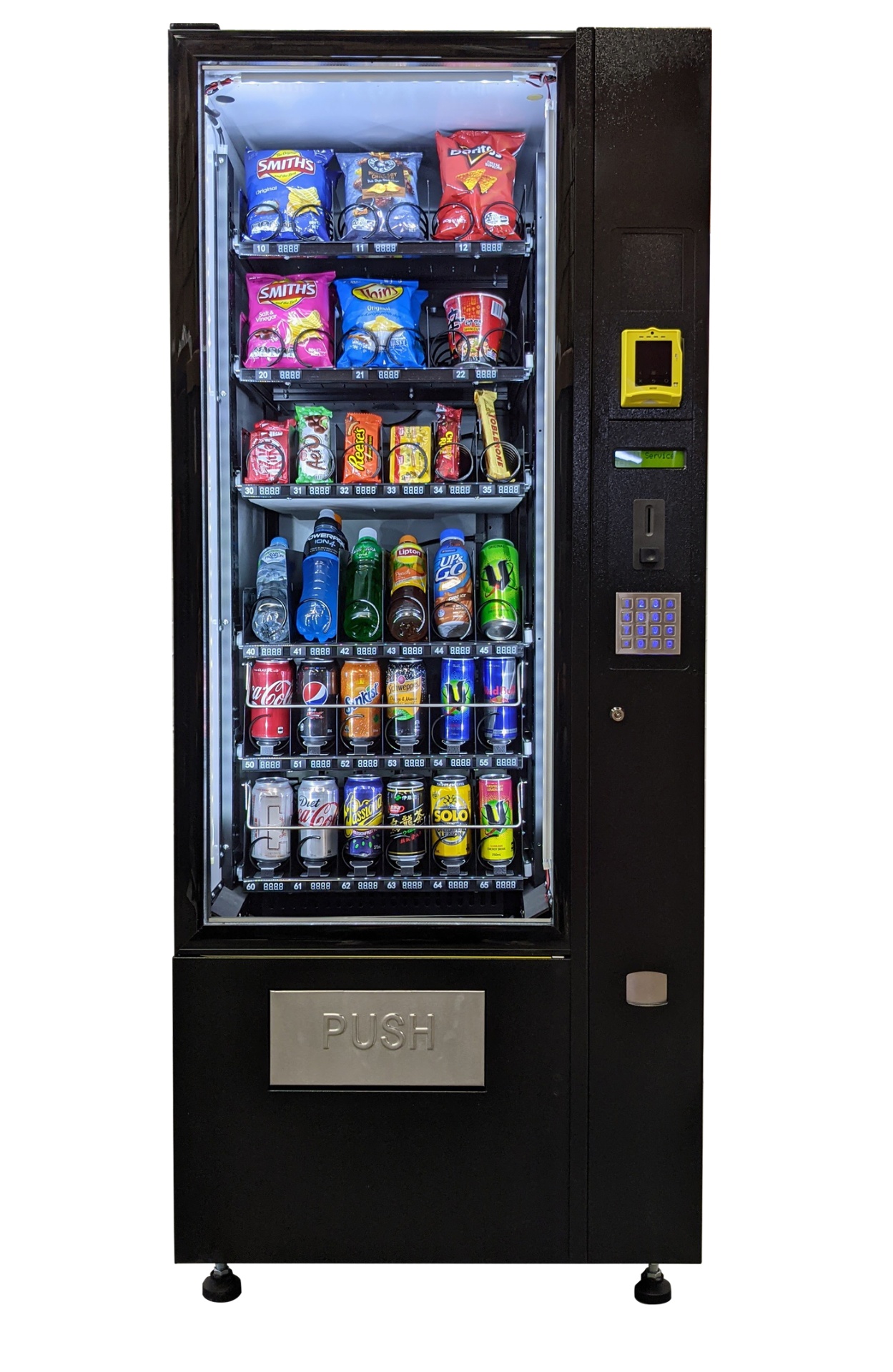
CV3 combo — slimline snack & drink
890mm wide · 1830mm high · 830mm deep
- Best for 15–40 staff, tight lift lobbies and narrow doorways to lunchrooms
- 6 shelves: 2 crisps, 1 confectionery, 3 refrigerated drink rows
- Nayax tap reader — Visa, Mastercard, Amex, Apple Pay, Google Pay
- Standard 10-amp GPO, no plumbing, no data cabling
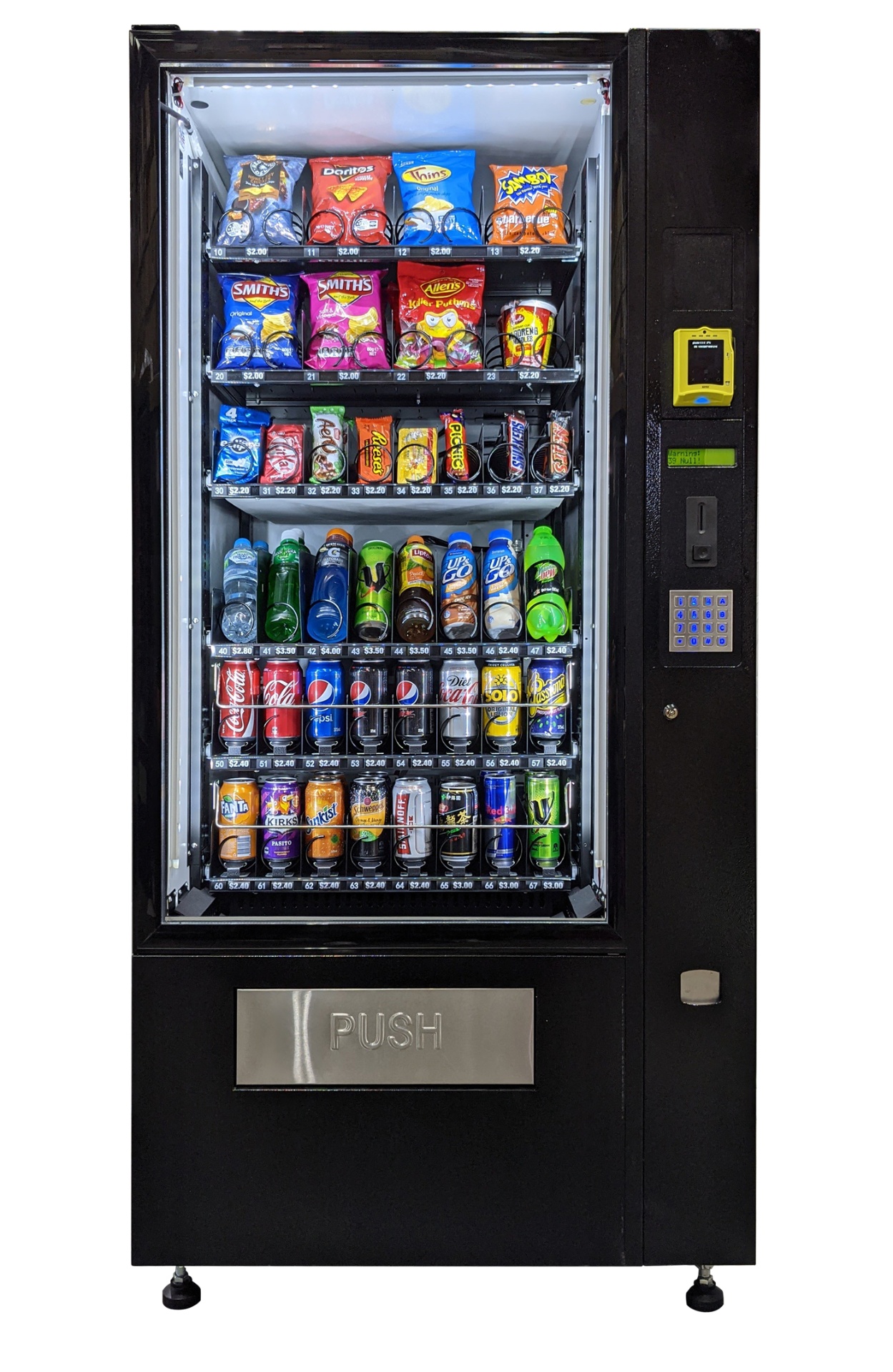
CV4 combo — mid-size with priced shelf labels
1000mm wide · 1830mm high · 830mm deep
- Best for 40–90 staff or a shared floor between two tenancies
- Live per-shelf pricing labels so staff see the cost before selecting
- Wider drink bays for 600ml bottles, iced coffee and energy cans
- Telemetry reports each vend, so restocks are scheduled on real data
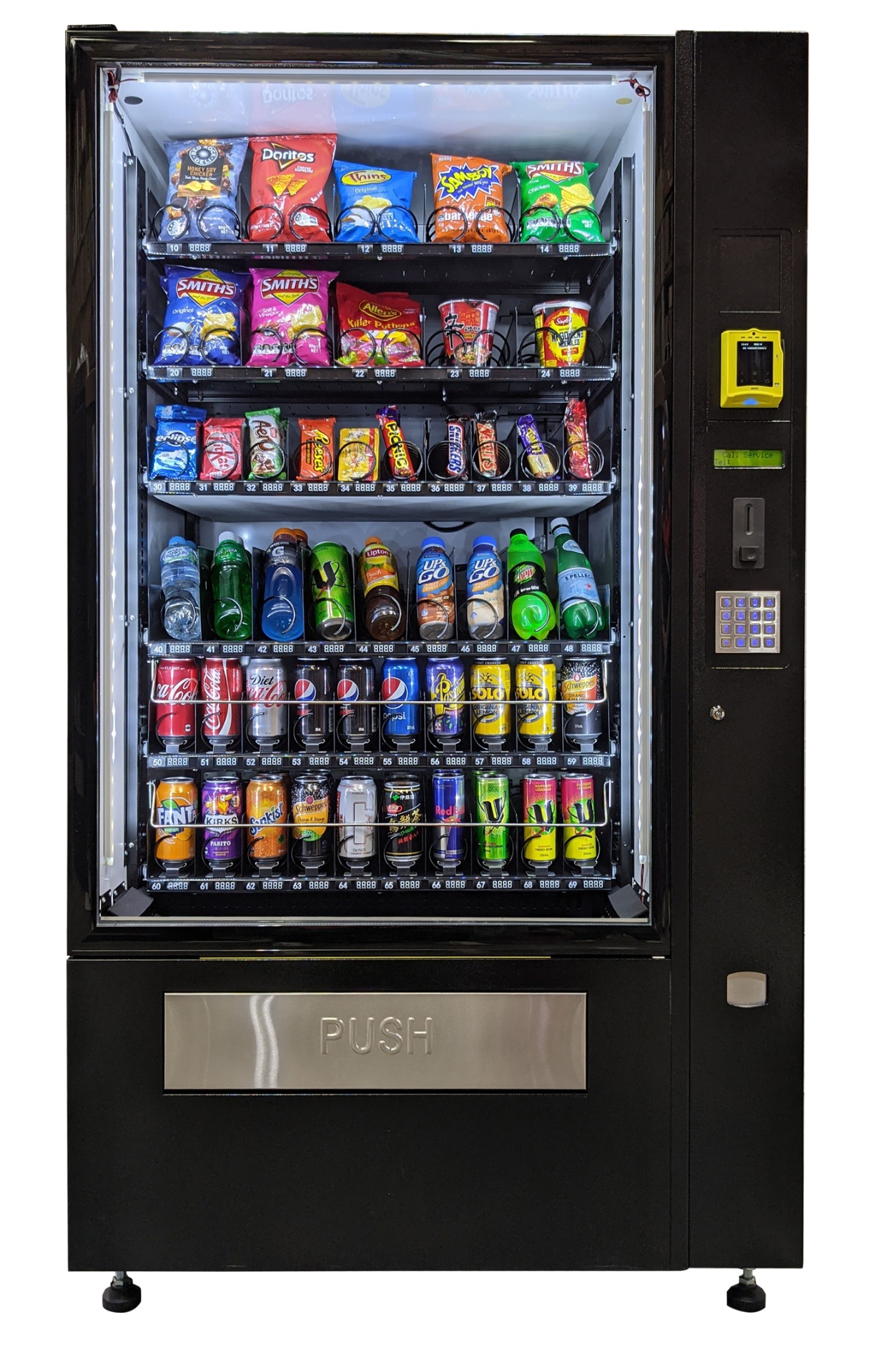
CV5 combo — high-capacity site machine
1200mm wide · 1830mm high · 880mm deep
- Best for 90+ staff, 24/7 shift sites, warehouses and gyms
- Up to 60 selections — the widest range we can put on one footprint
- Reinforced glass and hardened electronics for industrial floors
- Twin-bank refrigeration keeps drinks cold through summer peaks
FAQ
Frequently asked questions
How long does a vending machine take to pay for itself?+
It depends on site size and machine cost. Busy multi-shift sites can pay back within a year; small offices may take several years.
Should I include finance repayments?+
Measure payback on contribution before repayments, then separately confirm repayments are affordable each month.
What is a good payback period?+
Many operators look for conservative payback under two to three years, well inside any finance term.
How can I shorten payback?+
Choose high-headcount sites, match the range, buy well-maintained refurbished machines and tighten restock rounds.
Grow your local presence
Free guides on local SEO, vending costs, ROI and business planning.
Ready for a free vending machine at your workplace?
Two quick questions and you're on your way. No contract lock-ins, no hidden fees.