Vending business plan
Vending business plan: startup costs, shift scheduling, drink run costs and profit margins
A vending business is a route business. Profit comes from placing machines where people are hungry and thirsty at hours when nothing else is open, then servicing them efficiently enough that fuel, time and stock spoilage do not eat the margin. This plan walks through the numbers in the order an operator meets them.
What is vending business plan?
A vending business plan is a written outline of where machines will be placed, what they will sell, what they cost to buy and run, how often they will be restocked, and how much profit each machine is expected to make after stock, fuel, fees and finance.
Last reviewed 19 October 2026
Startup costs
The largest cost is the machines. New combination or refrigerated drink machines with card readers typically cost several thousand dollars each, while refurbished units cost less but may need more maintenance. On top of the machine sit the cashless payment reader and its monthly fee, the opening stock, delivery and installation, public liability and product insurance, and a vehicle suitable for carrying stock.
The figures below are illustrative ranges for planning only; get current quotes before committing.
| Item | Illustrative range (AUD) | Notes |
|---|---|---|
| Refurbished machine | $3,000 – $6,000 | Check refrigeration and parts availability |
| New combo or drink machine | $7,000 – $14,000 | Usually includes warranty |
| Cashless reader | $300 – $700 + monthly fee | Most sales are now card or phone |
| Opening stock per machine | $400 – $900 | Depends on capacity and mix |
| Insurance | $800 – $2,000 a year | Public liability is usually required by hosts |
| Vehicle and trolley | Existing or financed | Van or ute with secure storage |
Choosing sites and the free-host model
Most workplace machines are placed on a free-host basis: the business provides floor space and power, and the operator supplies, stocks and services the machine at no cost to the host. Good sites have a steady headcount, long shifts, limited nearby food and a room where staff take breaks. Warehouses, factories, workshops, mine-support yards and large offices fit that profile.
Before placing a machine, estimate daily sales: headcount multiplied by the share likely to buy each day multiplied by the average spend. A fifty-person warehouse where a third of staff buy one drink and one snack a day can support a machine comfortably; a ten-person office usually cannot on its own.
Shift scheduling and restock rounds
Restock rounds should follow the customers' shifts, not the operator's preference. Servicing a warehouse machine at 5:30am before the day shift arrives keeps it full for the busiest hours. A site running three shifts may need two visits a week where a day-only office needs one every fortnight.
Remote telemetry from the card reader shows exactly what has sold, so each round can be pre-picked at the depot. Group sites geographically into fixed rounds by day: one day for the western industrial belt, another for the south-east estates, another for regional runs. Plan extra capacity for known peaks such as shutdowns, harvest and crushing seasons, and the summer heat that lifts cold drink sales.
Drink run costs, both sides of the ledger
For the operator, the drink run is the cost of servicing: fuel, vehicle running costs and the driver's time. A round of ten machines covering 120 kilometres might cost $40 to $60 in fuel and vehicle wear plus four to six hours of labour. Dividing that by the machines serviced gives a per-visit cost that every site must cover.
For the host business there is a second drink run: staff leaving site to buy food and drinks. If fifteen people spend eighteen minutes each on a daily trip, that is 270 paid minutes a day. At $35 an hour all-in that is about $157 a day, or more than $780 a week, before counting stalled work. That figure is the strongest argument in a placement pitch, because a free machine removes it at no cost.
Profit margins
Gross margin is the difference between selling price and stock cost. Drinks and snacks typically carry a gross margin of 40 to 60 percent before other costs. From that come card fees, any commission paid to the host, servicing costs, insurance, machine finance or depreciation, and spoilage.
Our own machines average $4.40 per vend and a typical workplace machine sells 50 to 80 vends a week, or $220 to $352 in weekly sales. At the middle of that range, 65 vends, a machine takes $286 a week. Assuming a 50 percent gross margin, that is $143 gross. Subtract about $9 in card fees, a $25 servicing share and $15 for insurance and sundries, and it contributes about $94 a week, or roughly $4,900 a year, before finance. At 50 vends the same machine contributes about $63 a week ($3,300 a year); at 80 vends about $125 a week ($6,500 a year). Those figures feed directly into the payback and ROI calculations.
One-page vending business plan template
Fill in each line before buying your first machine. If a line cannot be answered, that is the next piece of research to do.
- Target area: suburbs and precincts, with postcodes.
- Target sites: site types, headcount, shifts.
- Machines: number, type, new or refurbished, total cost.
- Range: drinks, snacks, food and price points.
- Rounds: days, sites per round, kilometres and hours.
- Costs: stock, fuel, card fees, insurance, finance.
- Expected weekly sales and contribution per machine.
- Payback period and break-even number of machines.
- Growth: how and when the next machines will be added.
Experience you can check
Who installs your machine in Australia, and exactly how it runs
Written and maintained by Dan Barnes — owner-operator, Free Vending Machines Australia
I have been placing and servicing vending equipment in Australian workplaces for over two decades — offices, warehouses, gyms, hospitals, schools, remote camps and government sites. Everything on this page reflects how we actually run installs across every state and territory: the machines we physically stock, the lead times our crews hold to, and the service standard we carry at our own cost. Nothing here is licensed boilerplate.
- Typical Australian lead time: 7–14 days from a qualified request to a working machine.
- $20 million public liability plus product liability — certificate of currency supplied to your facilities or WHS team on request.
- Australian-owned, Australian-serviced. Same operator answers the phone on0401 NO COST.
- Nayax cashless readers and live telemetry on every machine — not a retro-fitted coin mech.
What to expect, step by step
1. Two-question request
You tell us the workplace type and rough head count. No paperwork, no credit check, no sales visit required to get an answer.
2. Site check within 24 hours
We confirm head count, foot traffic, power location and access (lifts, stairs, loading dock, after-hours security) and pick the right machine.
3. Delivery and install
Our crew delivers, levels and commissions the machine, tests the cashless reader end-to-end and takes the packaging away. Nothing is invoiced.
4. Telemetry goes live
Every vend, temperature reading and fault code streams back to us. Low stock is flagged 2–3 days before a row empties.
5. Ongoing service, still $0
Restocks, cleaning, repairs, parts, product-mix changes and $20m public liability are all carried by us. Ask us to remove it and we do — no exit fee.
The exact machines we install
These are our three workhorse combination machines — photographed as they leave our workshop, stocked with the Australian brands your team actually buys. We recommend one based on your head count and floor space, never on what happens to be in the truck.
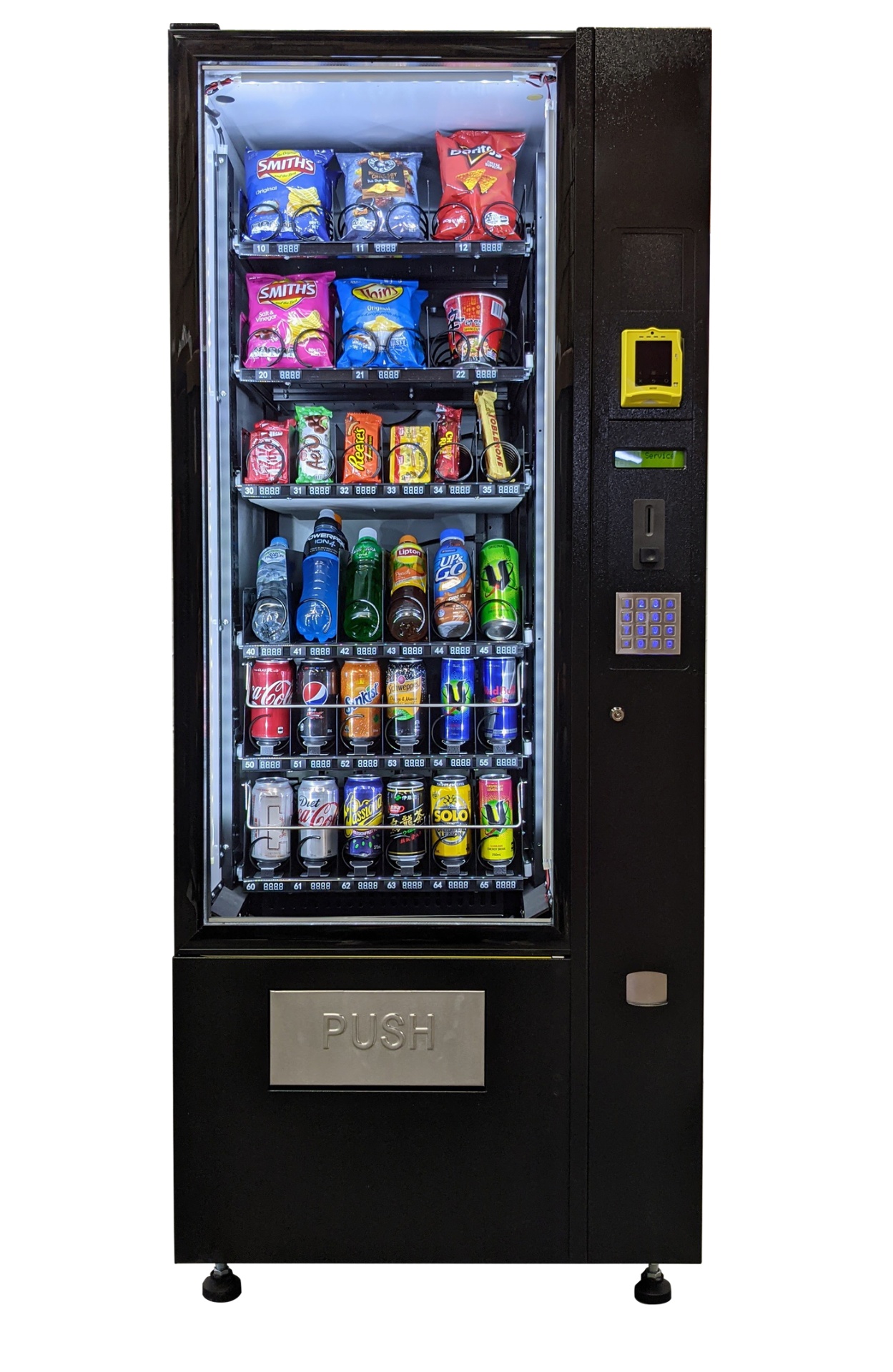
CV3 combo — slimline snack & drink
890mm wide · 1830mm high · 830mm deep
- Best for 15–40 staff, tight lift lobbies and narrow doorways to lunchrooms
- 6 shelves: 2 crisps, 1 confectionery, 3 refrigerated drink rows
- Nayax tap reader — Visa, Mastercard, Amex, Apple Pay, Google Pay
- Standard 10-amp GPO, no plumbing, no data cabling
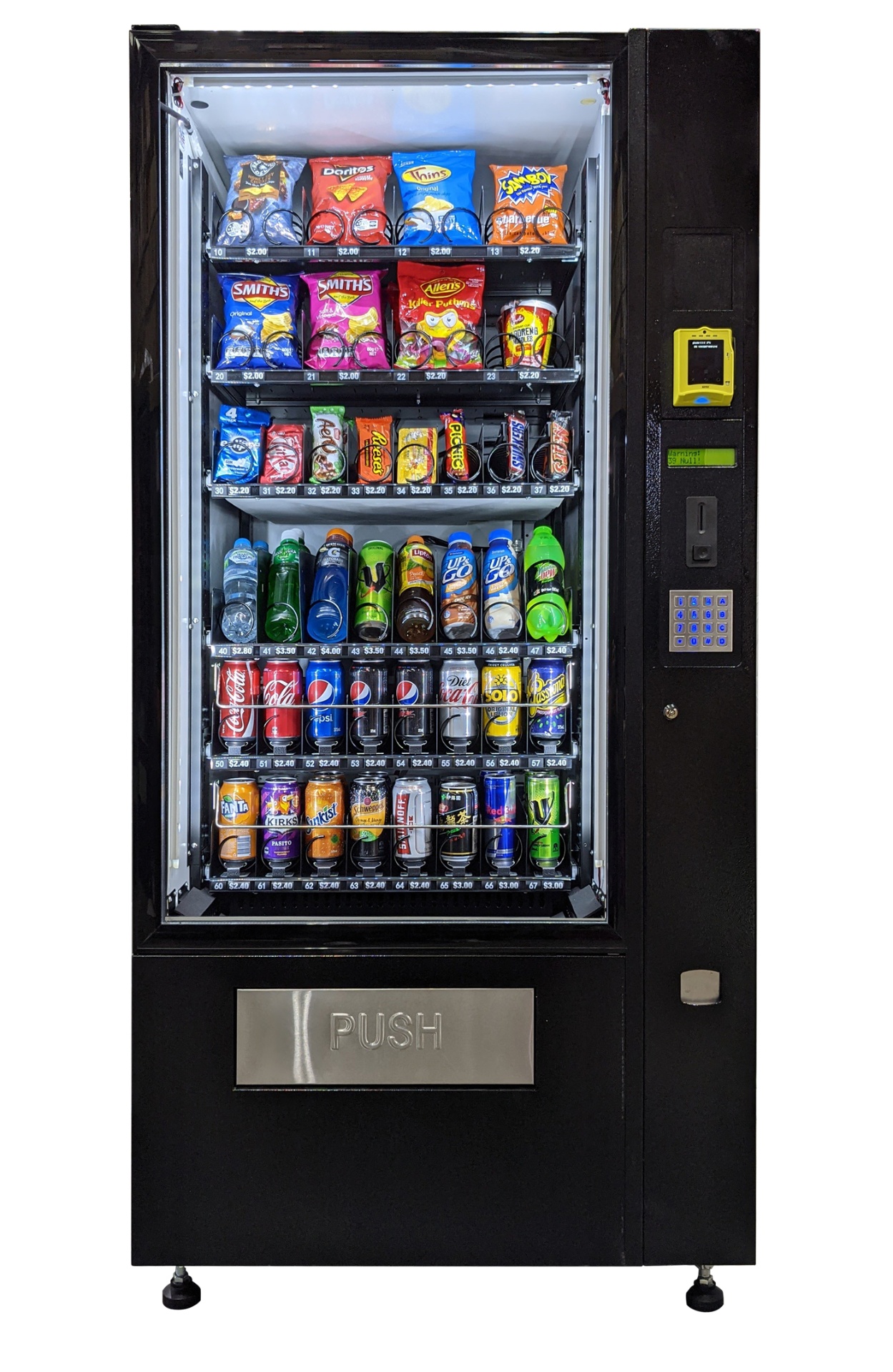
CV4 combo — mid-size with priced shelf labels
1000mm wide · 1830mm high · 830mm deep
- Best for 40–90 staff or a shared floor between two tenancies
- Live per-shelf pricing labels so staff see the cost before selecting
- Wider drink bays for 600ml bottles, iced coffee and energy cans
- Telemetry reports each vend, so restocks are scheduled on real data
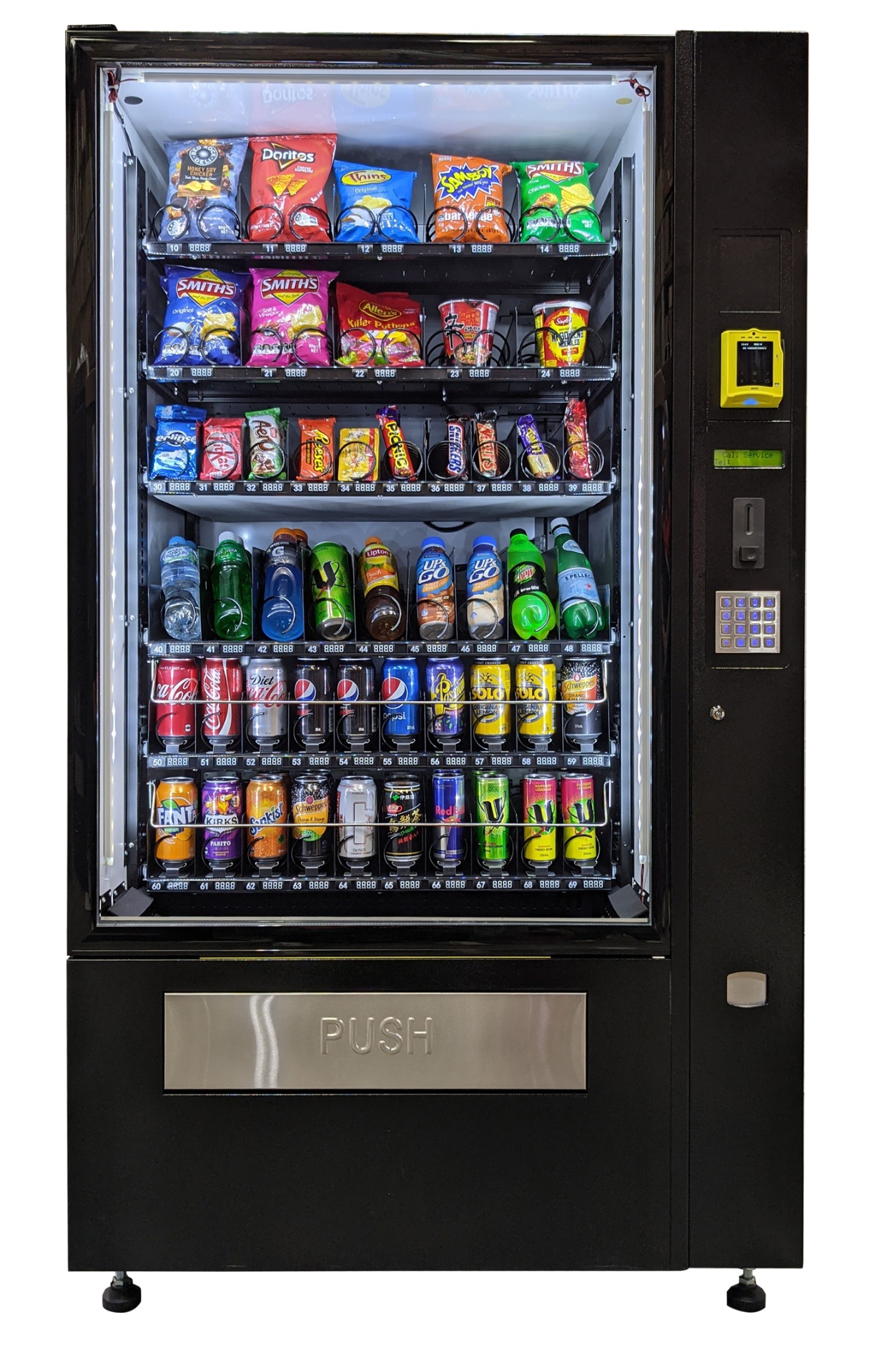
CV5 combo — high-capacity site machine
1200mm wide · 1830mm high · 880mm deep
- Best for 90+ staff, 24/7 shift sites, warehouses and gyms
- Up to 60 selections — the widest range we can put on one footprint
- Reinforced glass and hardened electronics for industrial floors
- Twin-bank refrigeration keeps drinks cold through summer peaks
FAQ
Frequently asked questions
How much does it cost to start a vending business in Australia?+
It depends on machine count and whether units are new or refurbished. A small start with a few refurbished machines can be done for well under the cost of one new unit per site.
What margin do vending machines make?+
Gross margins on drinks and snacks typically sit between 40 and 60 percent before card fees, servicing, insurance and finance.
How often should machines be restocked?+
Follow sales data. Busy multi-shift sites may need two visits a week; quiet offices one visit a fortnight.
Do hosts pay for the machine?+
Under the free-host model they do not. The operator supplies, stocks and services the machine.
Grow your local presence
Free guides on local SEO, vending costs, ROI and business planning.
Ready for a free vending machine at your workplace?
Two quick questions and you're on your way. No contract lock-ins, no hidden fees.