Cost breakdown

Free vending machine hire cost, line by line

Every line item most vending contracts charge for — rental, delivery, install, restocking, servicing, insurance — and what you actually pay for each on a free vending machine hire in Australia.

Free vending machine hire cost, line by line — free vending machine hire
$0 Delivery
$0 Installation
$0 Maintenance
$0 Insurances
$0 Restocking

The cost breakdown

What you'd pay vs what you pay on free hire

"Free vending machine hire cost" is the number-one question we get asked, and the honest answer is $0 across every standard line item. Where free hire differs from paid rental or purchase is the underlying business model: the provider funds the program from product margin, so your staff still pay normal cashless prices at the machine but the business hosting the machine pays nothing. Below is exactly what a paid rental or lease would charge, and what free hire charges instead.

Line itemTypical paid rentalFree hire
Monthly rental / lease$150–$600$0
Delivery to your site$150–$450$0
Install, level & network$150–$300$0
Restocking & cleaning$60–$120/visit$0
Insurance & liability$30–$80/mo$0

What's included at $0

  • Rental / lease fee — normally $150–$600/month → $0
  • Delivery to site — normally $150–$450 one-off → $0
  • Installation, levelling and network setup — normally $150–$300 → $0
  • Product stock (initial fill and top-ups) — normally 100% at cost → $0 to the host
  • Weekly restocking and cleaning labour — normally $60–$120/visit → $0
  • Cashless card reader + telemetry — normally $500+ hardware → $0
  • Machine insurance and product-liability — normally $30–$80/month → $0
  • Repairs and parts — normally billed hourly → $0

FAQ

Cost breakdown — FAQ

How much does it really cost to hire a vending machine?+

A paid commercial hire in Australia typically runs $150–$600/month plus stock, insurance and service fees. A free vending machine hire like this program is $0 — the provider recovers costs through product margin, not from the host.

Are there any hidden fees on free vending machine hire?+

No hidden fees. No power reimbursement, no admin charge, no exit fee. The only thing the host provides is the floor space and a standard 10-amp power outlet.

What about the electricity cost of running the machine?+

A modern cashless combo machine draws roughly $8–$18 of electricity per month — the host absorbs that, and it's the only running cost of any kind. LED-lit smart coolers can be as low as $5/month.

Does "free" mean cheap or refurbished machines?+

No. Our free hire program uses current-generation cashless machines (Necta Concerto, Crane Coti, FAS Lydia, Vendo VUE, Beverley combo, smart fridges) — the same models used in premium paid installs.

Is the vending machine hire really free — no contract or hidden fee?+

Yes. Rental is $0. Delivery is $0. Install is $0. Restocking, cleaning, servicing and product liability insurance are $0. The program is funded entirely by the products sold from the machine. No lock-in contract — if it stops suiting you, we collect the machine at no cost.

Who owns the machine on a free hire arrangement?+

We do. That's why maintenance, insurance, restocking and eventual removal are our responsibility, not yours. You're hosting the machine, not leasing it.

What's the minimum staff or foot traffic to qualify for free hire?+

About 30 daily on-site people is the working threshold for a standalone drink or snack combo machine. Below that we can still discuss micro-market or shared-site setups.

Can we swap or relocate the machine after install?+

Yes. Product mix reviews are ongoing and free. If you move offices or the current spot isn't working, we relocate the machine at no cost.

Experience you can check

Who installs your machine in Australia, and exactly how it runs

Written and maintained by Dan Barnes — owner-operator, Free Vending Machines Australia

I have been placing and servicing vending equipment in Australian workplaces for over two decades — offices, warehouses, gyms, hospitals, schools, remote camps and government sites. Everything on this page reflects how we actually run installs across every state and territory: the machines we physically stock, the lead times our crews hold to, and the service standard we carry at our own cost. Nothing here is licensed boilerplate.

  • Typical Australian lead time: 7–14 days from a qualified request to a working machine.
  • $20 million public liability plus product liability — certificate of currency supplied to your facilities or WHS team on request.
  • Australian-owned, Australian-serviced. Same operator answers the phone on0401 NO COST.
  • Nayax cashless readers and live telemetry on every machine — not a retro-fitted coin mech.

What to expect, step by step

  1. 1. Two-question request

    You tell us the workplace type and rough head count. No paperwork, no credit check, no sales visit required to get an answer.

  2. 2. Site check within 24 hours

    We confirm head count, foot traffic, power location and access (lifts, stairs, loading dock, after-hours security) and pick the right machine.

  3. 3. Delivery and install

    Our crew delivers, levels and commissions the machine, tests the cashless reader end-to-end and takes the packaging away. Nothing is invoiced.

  4. 4. Telemetry goes live

    Every vend, temperature reading and fault code streams back to us. Low stock is flagged 2–3 days before a row empties.

  5. 5. Ongoing service, still $0

    Restocks, cleaning, repairs, parts, product-mix changes and $20m public liability are all carried by us. Ask us to remove it and we do — no exit fee.

The exact machines we install

These are our three workhorse combination machines — photographed as they leave our workshop, stocked with the Australian brands your team actually buys. We recommend one based on your head count and floor space, never on what happens to be in the truck.

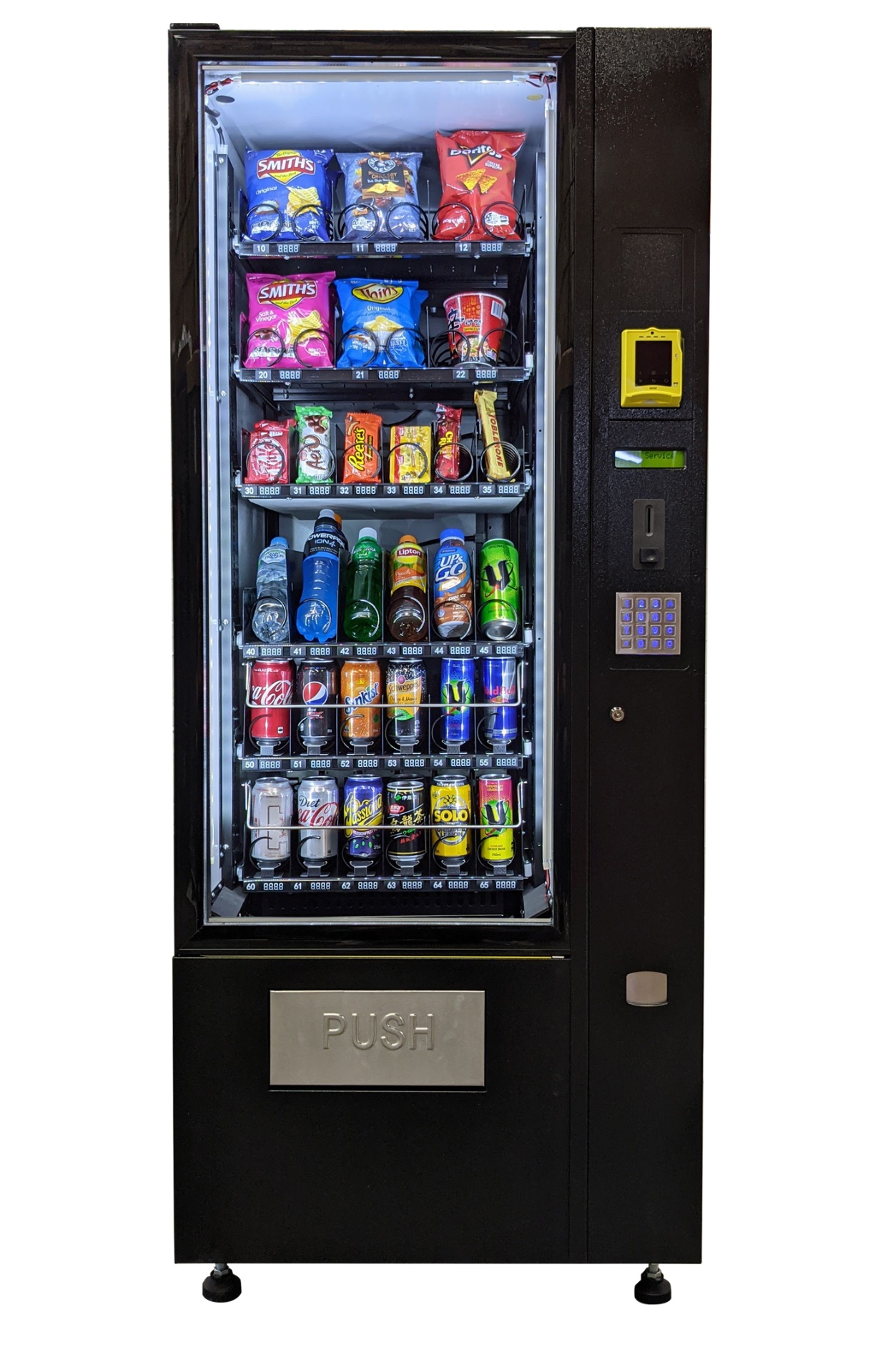
CV3 combination vending machine front view with Nayax tap-and-go card reader, stocked with Australian chips, chocolate bars and chilled cans

CV3 combo — slimline snack & drink

890mm wide · 1830mm high · 830mm deep

  • Best for 15–40 staff, tight lift lobbies and narrow doorways to lunchrooms
  • 6 shelves: 2 crisps, 1 confectionery, 3 refrigerated drink rows
  • Nayax tap reader — Visa, Mastercard, Amex, Apple Pay, Google Pay
  • Standard 10-amp GPO, no plumbing, no data cabling
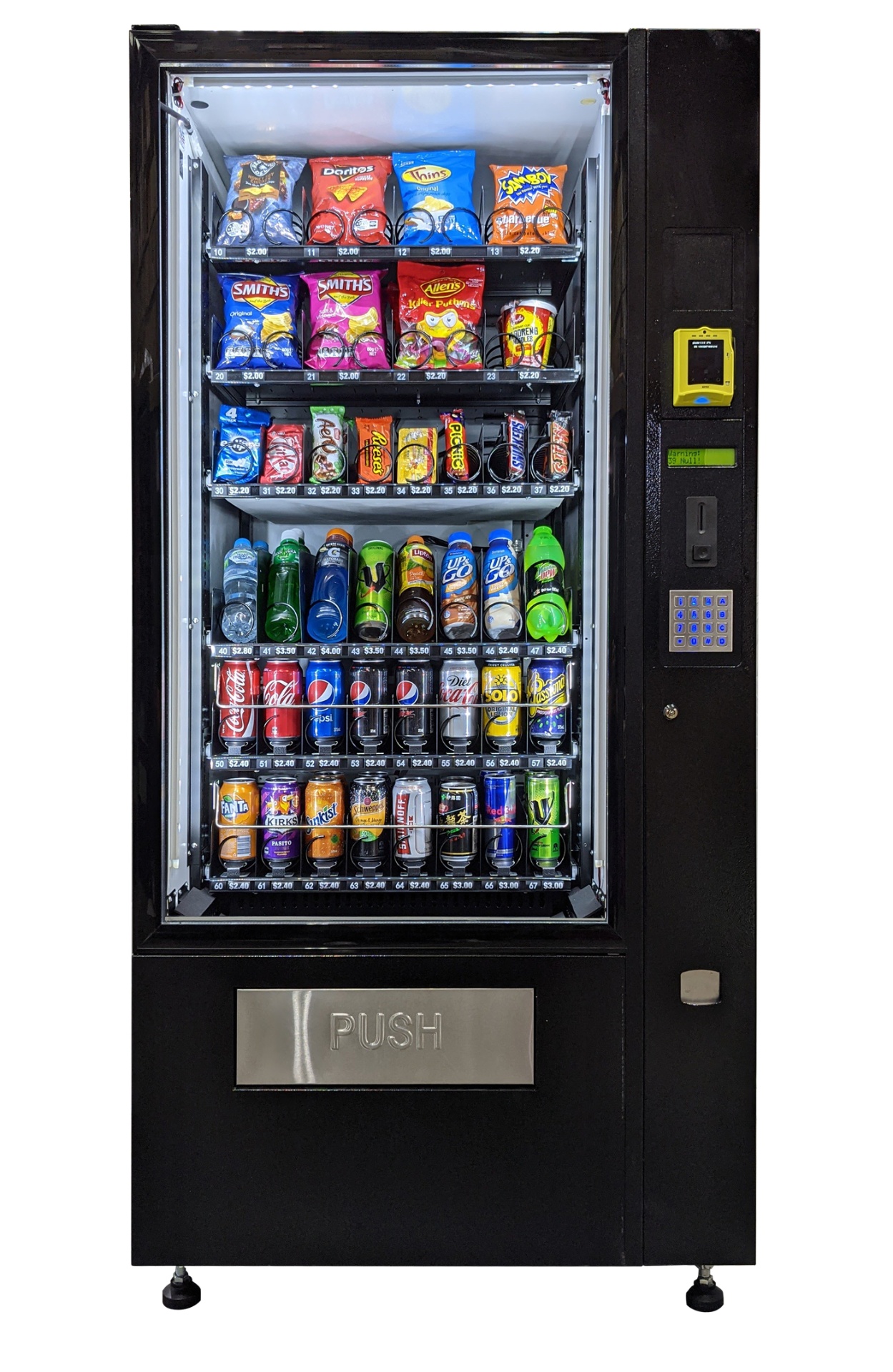
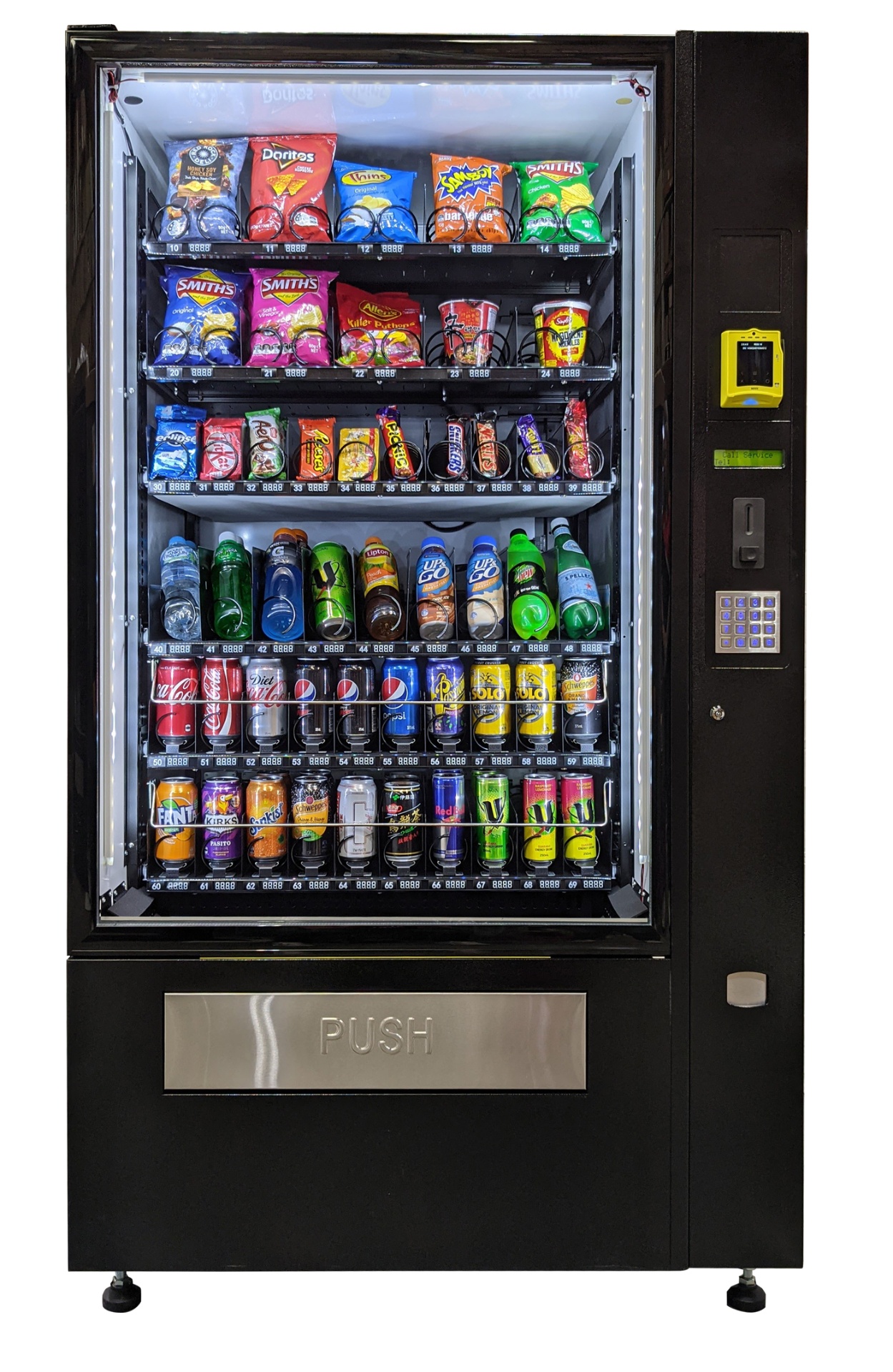
CV4 combination vending machine with printed shelf pricing, snacks, noodle cups and refrigerated soft drinks behind glass

CV4 combo — mid-size with priced shelf labels

1000mm wide · 1830mm high · 830mm deep

  • Best for 40–90 staff or a shared floor between two tenancies
  • Live per-shelf pricing labels so staff see the cost before selecting
  • Wider drink bays for 600ml bottles, iced coffee and energy cans
  • Telemetry reports each vend, so restocks are scheduled on real data
CV5 large combination vending machine fitted with Nayax cashless reader, six shelves of snacks and a full chilled drink bank for busy Australian workplaces

CV5 combo — high-capacity site machine

1200mm wide · 1830mm high · 880mm deep

  • Best for 90+ staff, 24/7 shift sites, warehouses and gyms
  • Up to 60 selections — the widest range we can put on one footprint
  • Reinforced glass and hardened electronics for industrial floors
  • Twin-bank refrigeration keeps drinks cold through summer peaks

Proof

Australian workplaces that said yes — and what changed

All case studies

Office · Barangaroo, NSW

Barangaroo pro-services firm — free combo machine on floor 34

  • 9 daysInstall lead time
  • $0Cost to the firm
  • 40–60Transactions/day

Booking the dock and getting building management to approve a vendor is usually painful. This crew handled all of it — the machine appeared, plugged in, and the staff just started using it.

Read the write-up
Warehouse · Truganina, VIC

Truganina distribution centre — 24/7 vending for a 3-shift operation

  • 11 daysInstall (2 machines)
  • 24/7Availability
  • 3 shiftsServiced

Night shift was tapping vending machines in the servo across the road. Now they don't leave the site. It's paid for itself in productivity in the first month — and we paid nothing for it.

Read the write-up

Gym · Fortitude Valley, QLD

Fortitude Valley 24/7 gym — recovery drinks + protein bars at $0 cost

  • 7 daysInstall lead time
  • $0Owner outlay
  • +$6Avg member spend / visit

I'd been quoted $8k for a machine that I'd have to stock and fix. This one turned up free, gets stocked automatically, and I get a monthly line item as revenue not a cost. No brainer.

Read the write-up
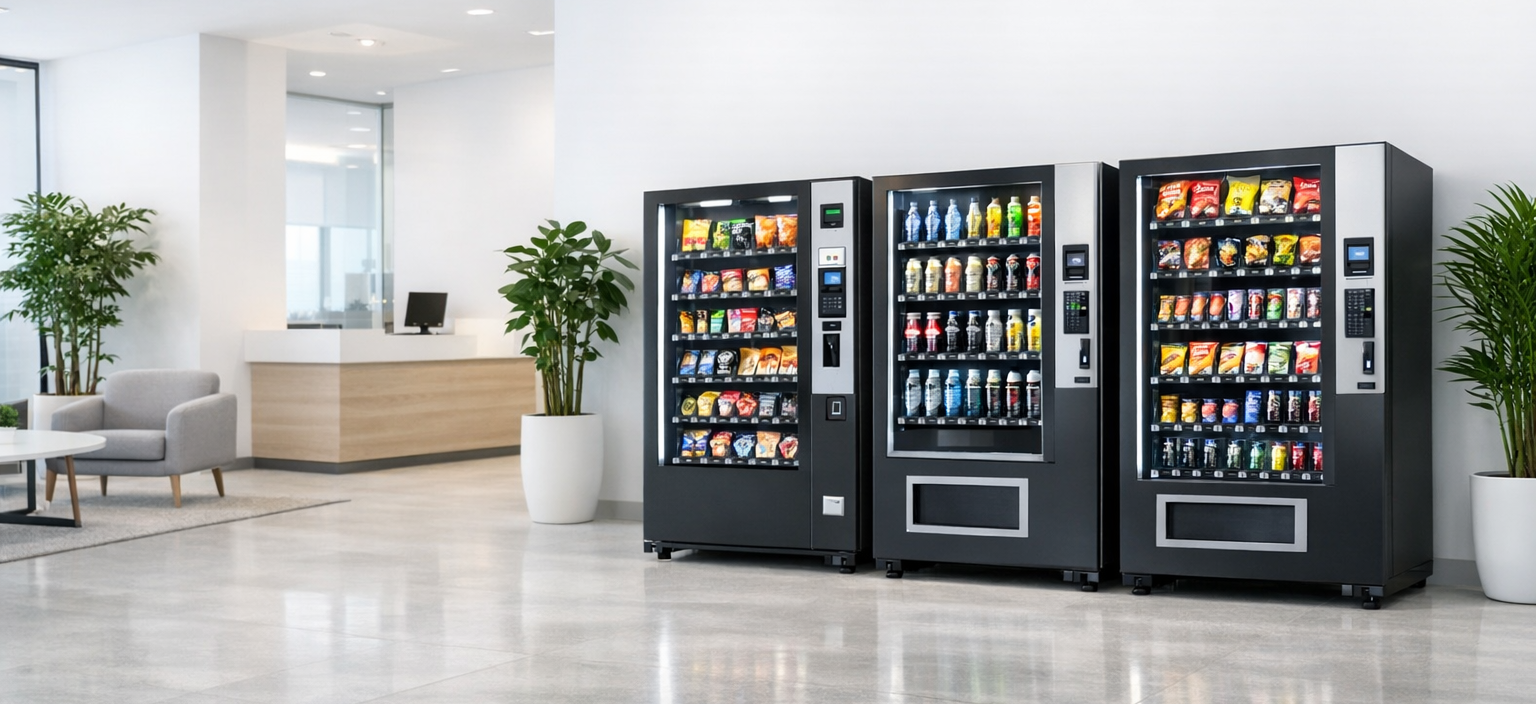
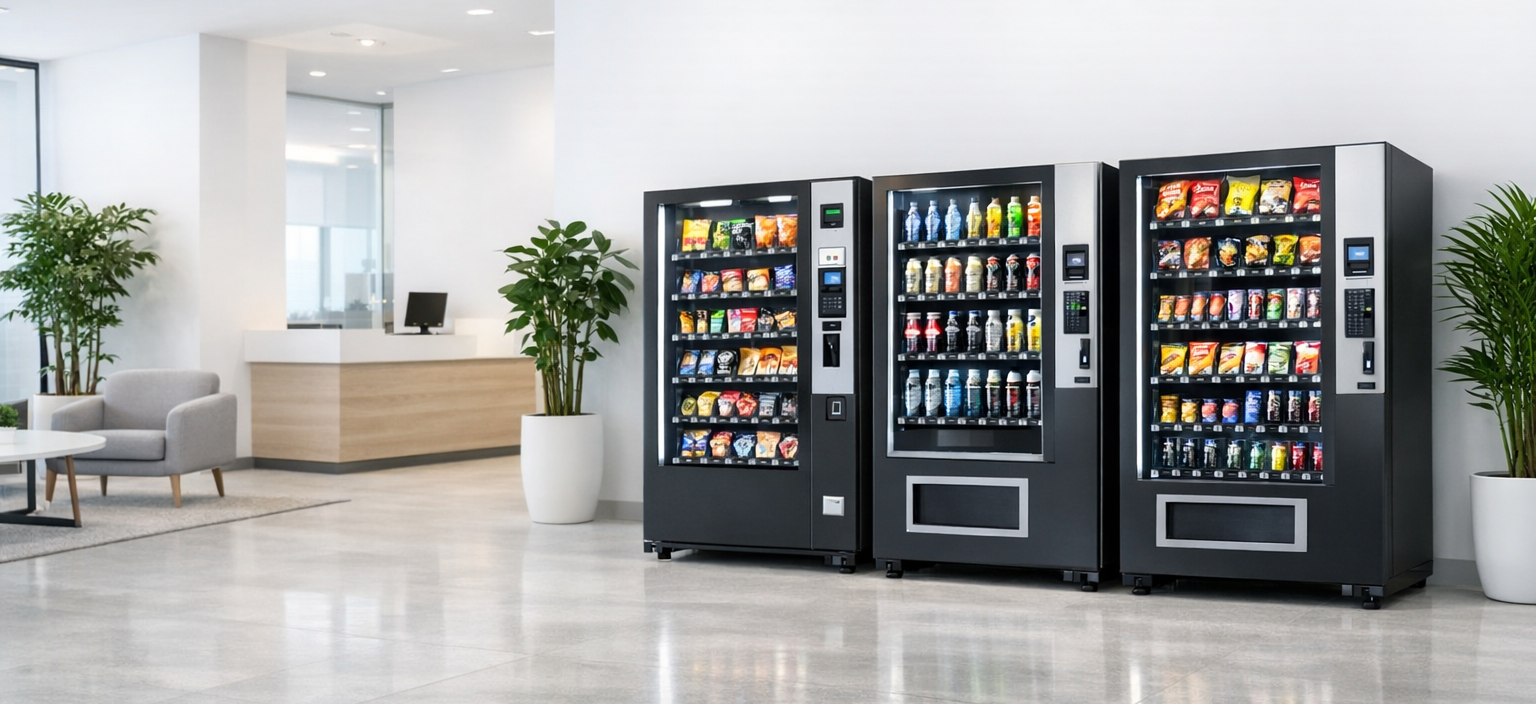
Free snack and drink vending machine installed in an Australian corporate office lobby
Corporate lobby install — snack and cold-drink combo, $0 to the host site.
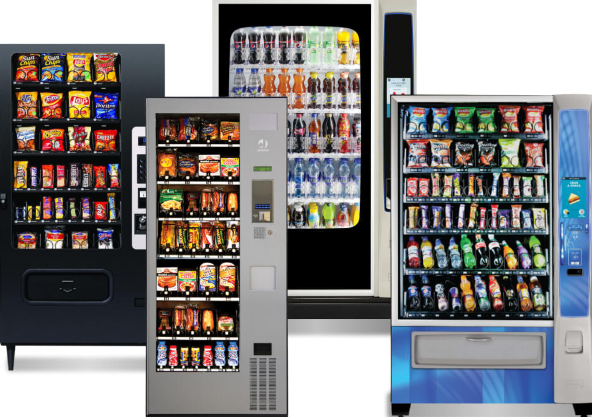
Line-up of four free workplace vending machines: snack, drink, combination and coffee
The four configurations we install: snack, drink, combination and coffee.
Telemetry-monitored smart fridge vending machine restocked automatically at an Australian workplace
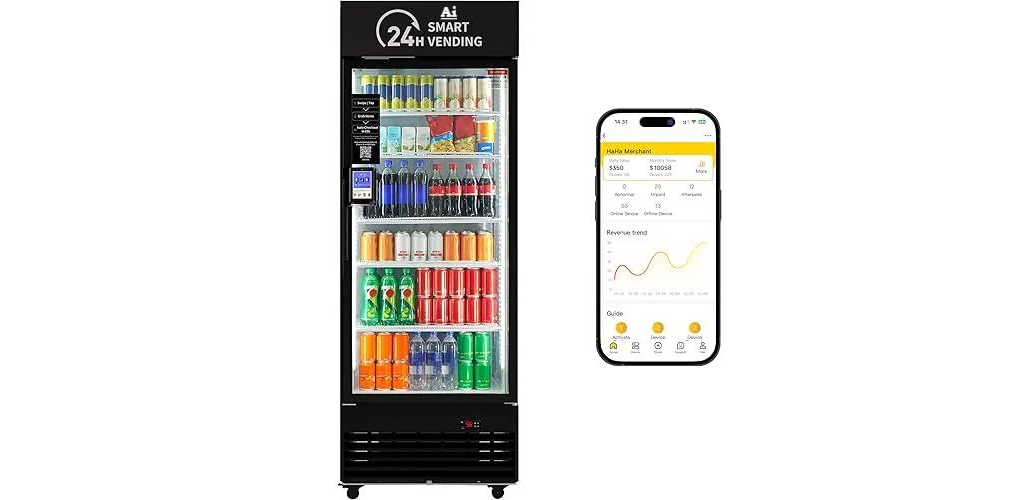
Telemetry-monitored smart fridge — restocks are triggered before it runs dry.

Ready for a free vending machine at your workplace?

Two quick questions and you're on your way. No contract lock-ins, no hidden fees.

The real cost of vending machine hire in Australia — and why ours is $0

What businesses normally pay

Priced vending in Australia usually arrives as a bundle that looks small line by line and adds up quickly. Monthly rental on a combination machine sits between $150 and $600 depending on capacity and payment hardware. Delivery is quoted at $150 to $450 and rises fast when a hoist, a lift booking or after-hours dock access is involved. Installation, levelling and network commissioning is another $150 to $300. Restock visits are billed at $60 to $120 each, typically fortnightly. Insurance riders and telemetry SIM fees add $30 to $80 a month.

A modest single-machine site therefore lands somewhere between $3,500 and $9,000 a year before a single can is sold — and that is before the cost of the person in your business who ends up chasing refunds, reporting faults and reconciling coin floats.

Where that cost goes on a free placement

On a free placement, every one of those lines is absorbed by the product margin. The machine is ours, so depreciation is ours. The delivery crew is ours, so access problems are ours to solve. The restocker is ours, so the fortnightly visit is scheduled off telemetry rather than a fixed invoice cycle. The card reader is ours, so settlement, chargebacks and refunds run through our merchant account, not yours.

The practical effect for a finance team is that vending stops being a cost centre with a recurring purchase order and becomes an amenity with no ledger entry at all. There is nothing to accrue, nothing to depreciate, and no supplier renewal to diarise.

The questions a CFO usually asks next

The first is whether prices to staff are inflated to cover the giveaway. They are not — shelf prices are set to normal convenience-retail levels, because a machine priced above the servo down the road stops selling and the whole model collapses. The second is whether there is a hidden commitment: there is not, and the absence of a term is what makes the model honest. The third is what happens if the machine underperforms. In that case we change the planogram, then the position, then the machine type, and only if none of that works do we collect it — at our cost.

Some hosts do ask about commission on sales. We are upfront that a free placement and a commission arrangement are different products: commission-bearing sites generally carry a rental or a higher shelf price. Most Australian workplaces we speak to prefer the clean version — nothing in, nothing out, a well-stocked machine that simply works.

  • $0 rental, $0 delivery, $0 install, $0 service, $0 insurance — no annual escalation
  • Typical paid-rental equivalent avoided: roughly $3,500–$9,000 per machine per year
  • No purchase order, no depreciation schedule, no supplier renewal to manage
  • Shelf pricing benchmarked to local convenience retail, not inflated to fund the machine
0401 662 678