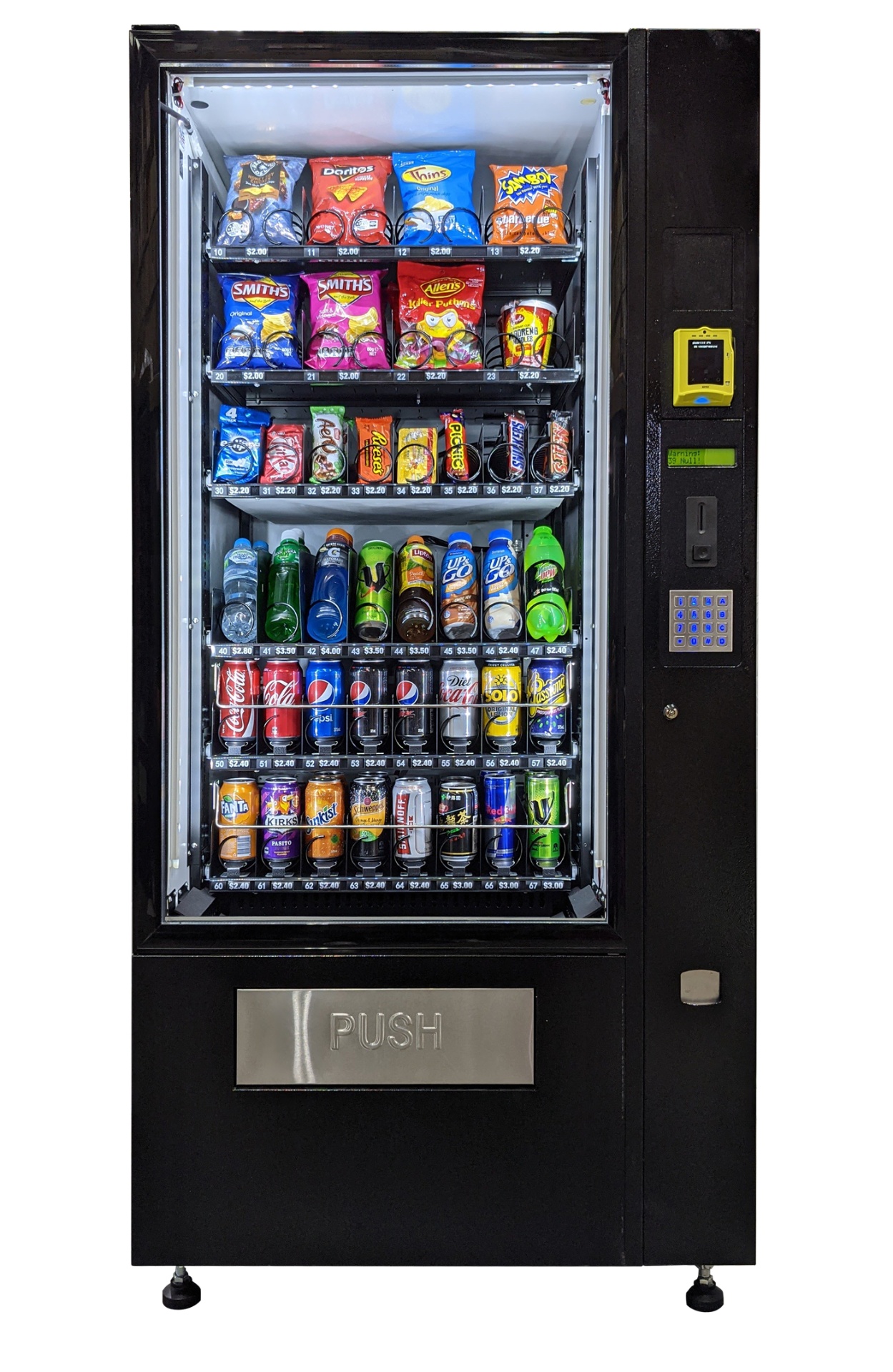
Australian offices have three legitimate paths to a vending machine: take one on the free placement program, buy the machine outright, or lease it. Each model has a genuine niche. This guide compares all three on the terms that actually matter to a facilities or office manager — capital outlay, five-year total cost, staff amenity, admin load, and what happens when something breaks. It also covers the machine types most offices choose, the staff-count thresholds under which each model makes sense, and the combination-machine option that dominates Australian office installs in 2026.
Why Australian offices install vending
Vending in an office is not really about snacks. It is about not losing forty minutes of productive time to the nearest cafe run, giving night-shift and weekend staff a real amenity, and having a low-friction option for hybrid workers who come in unpredictably and don't want to plan their food around office hours. The businesses that install vending in 2026 are the ones tracking amenity as part of return-to-office strategy — and increasingly the ones running suburban or industrial-estate offices where a coffee walk isn't practical.
Model 1 — free placement
Under free placement the vending operator installs a commercial machine, restocks it, services it, insures it, and takes all margin from product sales. The office pays nothing and earns no commission. This is the dominant model in Australian offices with 25+ staff for one reason: it is the only option with genuine zero total cost of ownership. There is nothing to depreciate, nothing to insure, nothing to service, no stock to buy. When the office moves floors or reorganises, the operator handles the move.
Free placement suits offices that want the amenity without the admin. It is not the right model for a business that wants to run vending as a small profit centre or that has a highly-specific product range no operator will carry.
Model 2 — buy the machine outright
A new commercial combination machine in Australia (snacks and drinks in one cabinet, cashless-ready, telemetry-enabled) sits at $8,000–$14,000 delivered and installed. Bean-to-cup coffee machines and smart-fridge units run higher. Ownership means the office keeps all product margin — usually 40–55% at Australian retail vend prices — but takes on stock procurement, restocking labour, service calls, coin and cashless fees, refrigerant compliance, and public liability insurance for the unit. Realistic ongoing cost is $200–$400 per month.
Buying makes sense when the office has an existing kitchen or facilities function that can absorb the restocking role, when product mix is specific enough that no operator will match it, or when the site sells a very high volume (rare in offices; more common in industrial mess rooms and 24/7 fitness). Break-even on capital outlay is typically 18–36 months.
Model 3 — lease
Leasing is the middle ground: fixed monthly payment ($80–$220 depending on machine and term), no capital outlay, and full ownership of stock and margin. The office still handles restocking and service scheduling, though most lease providers bundle a service plan. Lease terms are usually 36 or 60 months. This model suits offices that want the margin economics of ownership without the balance-sheet impact — commonly finance-driven decisions rather than facilities-driven ones.
Machine types for Australian offices
Combination machines
The default choice for Australian offices in 2026. A single cabinet with snacks in a spiral section and cold drinks in a refrigerated section. Small footprint (roughly 900mm wide), single power outlet, one machine to service. Cashless-ready as standard. Suits offices from 25 to about 150 staff.
Standalone snack + standalone drink
Two machines side-by-side. Doubles capacity, appropriate for offices over 150 staff or sites where combo throughput isn't keeping up. Costs roughly the same in staff time to service one combo vs two singles because the operator visit is one trip.
Smart fridge / grab-and-go
Open-fronted refrigerated cabinet where staff tap a card, take an item, and the reader charges automatically. Suits offices that want fresh food (salads, sandwiches, yoghurt, ready meals). Higher touch — items expire — so it's usually offered alongside a combo, not instead of one.
Office coffee (bean-to-cup)
Increasingly bundled with vending in 2026. Bean-to-cup machines fill the coffee gap; the combo covers cold drinks and snacks. See the separate free office coffee guide for how coffee-specific placement works.
Which model fits your office?
- 25–150 staff, no facilities team to spare, no need for commission → free placement.
- Under 25 staff but 24/7 access, or a shared floor with visitor traffic → free placement, subject to a suitability check.
- 150+ staff with in-house facilities and a specific product policy → buy or lease.
- Finance prefers opex over capex, office wants to keep margin → lease.
- Unusual site (art gallery, boutique consultancy, ten-person studio with high spend per head) → buy or lease; free placement won't clear the threshold.
Next step
The fastest way to know which model fits is the online suitability check — three questions, one-business-day reply, and a direct answer either way. If free placement fits, an install window is booked in the same call. If it doesn't, we'll point you toward the buy and lease options that make sense for the site size.
Free 60-second check. Straight answers only.
Next article
Free office coffee machines in Australia — how it works
Bean-to-cup coffee on the free placement model — who qualifies, what's included, and where it's available across Victoria, NSW, Queensland, WA and SA.
Read next →Related service
Free office vending — Australia
Fully-managed free workplace vending for Australian offices — every state, cashless, telemetry-managed, no lock-in.
See service page →DavidB, VMA
Vending operator & technician
DavidB has 20+ years of hands-on experience across the Australian vending industry. He has configured, installed, removed and transported thousands of machines — from full site rollouts to the quick "pick-up-and-move" jobs that keep a site happy. Starting in repairs, he learned from some of the industry's longest-serving technicians, covering everything from lock changes and fridge decks to vend motors, control boards, coin mechs and note readers. He was also among the earliest installers of Australia's first telemetry systems, helping shape what operators actually need in the back end: product imaging, stock sales, re-ordering, route planning and even catching thieving fillers who did not know the machine was monitored. Later, he moved into supplier roles across note readers, coin acceptors, credit card readers and other cashless acceptance methods including QR code and RFID systems for specialised vending such as PPE machines.