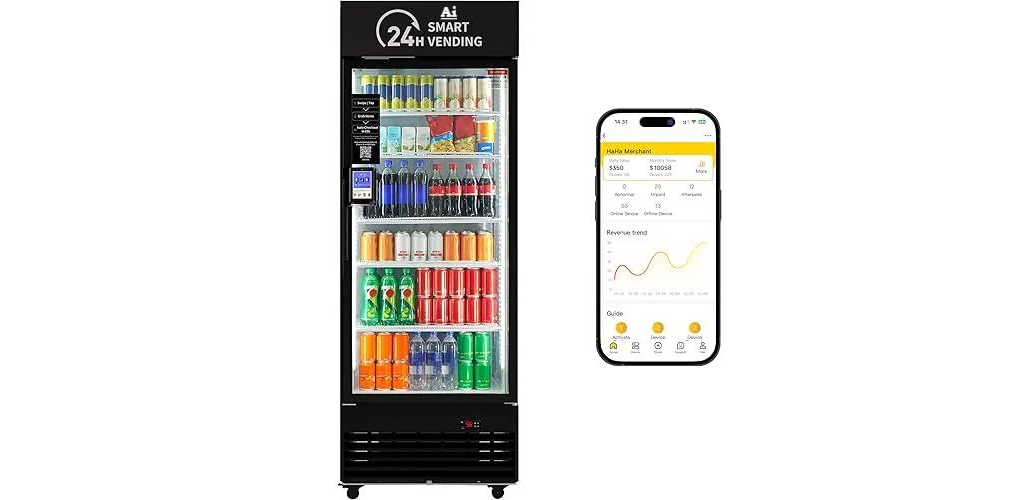
A smart fridge vending machine doesn't just sit in the corner waiting for staff to notice it's empty. On every new install we do across Australia in 2026, the machine watches its own shelves in real time and tells the operator — automatically — when a product is running low, when a shelf has been emptied, and when the fridge deck is holding temperature outside the food-safety window. The result is that most workplaces never actually see a 'sold out' machine. The refill happens before anyone has to email HR.
- Step 1
NFC/AI sensors detect the sale
Weight cells drop by exact SKU mass; camera vision confirms the item that left the shelf.
- Step 2
Telemetry uploads via 4G
Encrypted packet with stock, sales, deck temperature and faults every few minutes.
- Step 3
Restock alert triggered
Par-level breach flags the machine; fast-mover stock-outs escalate to same/next day.
- Step 4
Service visit dispatched
Filler follows a per-machine pick-list — no clipboard, no over-picking.
This is the loop every smart fridge on our Australian fleet runs — repeatedly, hands-free.
The sensors doing the actual work
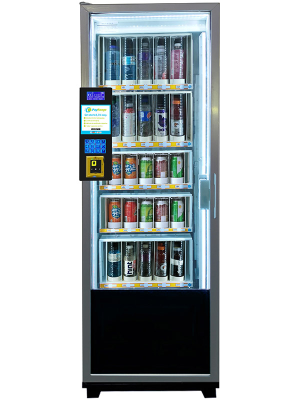
There are three technologies working together inside a modern smart fridge vending machine. The first is a load-cell (weight sensor) fitted under each shelf or under each product cradle. When a customer removes a bottle of Coke or a chicken salad, the weight drops by exactly the mass of that SKU, and the machine's control board increments a 'sold' event for that lane. The second is machine-vision cameras — typically one camera per door, sometimes two — that photograph the shelves after every open-close cycle. Onboard AI compares the 'before' and 'after' image and confirms which SKU actually left the fridge, catching edge cases where a customer put a product back or swapped it for another. The third is the fridge deck itself, which continuously reports evaporator temperature, ambient temperature, compressor duty cycle and door-open duration to the same telemetry board.
Together, these three data streams give the operator a real-time picture of what's in the machine, what just sold, and whether the food inside is safe to sell. There's no manual counting, no clipboard, and no guessing.
The telemetry loop — from shelf to service team
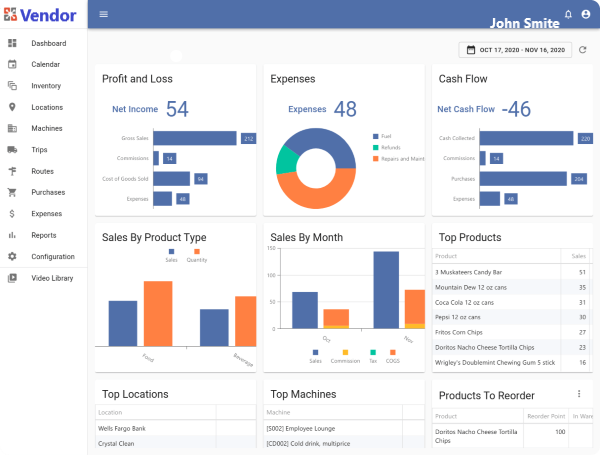
Every smart fridge on our fleet uploads a data packet over 4G every few minutes (Wi-Fi as a backup when the site has it). The packet contains the current stock level per SKU, sales since the last upload, the current deck temperature, any faults on the compressor or door sensor, and the status of the payment reader. That data lands in the operator's back-office platform — Nayax Management Suite, Vendcell VPortal, or a similar telemetry dashboard — where it's compared against a par-level rule set per site.
When any SKU drops below its site-specific par level, the back-office automatically flags the machine for a restock run. If a fast-moving line (say a chicken wrap in a warehouse smart fridge) empties before the scheduled route, the system escalates it: a filler is dispatched from the nearest depot, often the same or next day. If the deck temperature strays outside 1–5 °C for more than a few minutes, the machine is remotely disabled from selling that SKU class until a technician verifies it — which is a food-safety compliance feature, not a nice-to-have.
How the restock run is actually planned
Behind the automation is a route-optimisation engine that groups nearby machines with pending restocks into a single run. The filler's van gets a pick-list generated from the same telemetry — exactly what SKUs to pick, in what quantity, for which site. Nothing is estimated. Trolley loads land next to the machine with no over-picking and no wasted trips. That's how a single filler can service 20–30 workplaces in a day across Sydney, Melbourne, Brisbane, Perth or Adelaide without any of the machines running dry.
Food safety compliance — the part most people don't see
Smart fridge vending machines in Australia sell chilled and ready-to-eat food, so they sit under the same food-safety expectations as any commercial fridge — Food Standards 3.2.2, state health authority guidance, and the operator's own HACCP-style monitoring. The telemetry board logs deck temperature every minute, stored for at least the shelf-life of the product plus a retention buffer. If a fridge fails and temperature climbs above 5 °C, the affected SKUs are pulled remotely from the vend catalogue, the site is flagged for a technician visit, and the temperature log becomes the compliance evidence. Nothing sold outside the safe window, nothing recalled by hand.
What the host workplace actually has to do
This is where it gets almost boring. The workplace supplies floor space, a 240V outlet and a 4G-friendly window. That's it. Restocking, temperature monitoring, refunds on failed vends, cleaning of the interior, and machine faults are all handled by the operator through the telemetry stack. Providers like Free Vending Machines Australia handle all restocking and maintenance at zero cost to the host business, so the technology works entirely behind the scenes with no effort required from the site — no purchase orders, no receiving dock scheduling, no staff-manager involvement.
Why this is different from a traditional coin-op vending machine
A traditional coin-op snack machine gives the operator zero visibility. The filler shows up on a fixed route (say every 14 days), notes whatever is empty, and drives back to depot to pick. Fast-moving SKUs stay out of stock for days at a time. A smart fridge does the opposite: because the machine reports what's actually selling in near-real-time, the operator can push more of what a site is buying and pull what isn't. Six months in, the product mix at your workplace is genuinely optimised for your staff, not a national average.
Free quote
Request a free smart fridge vending machine
One-minute site check. If your workplace qualifies, we'll install a fully monitored smart fridge with AI restocking at $0 cost to the site — all filling, servicing and food-safety monitoring included.
Next article
Smart fridge vending machines in Australia — the restocking process explained
From the moment a bottle leaves the shelf to the moment a filler walks back in the door — the full Australian smart-fridge restocking process.
Read next →Related service
Request a smart fridge
Fully monitored smart fridge with AI restocking at $0 to the site.
See service page →DavidB, VMA
Vending operator & technician
DavidB has 20+ years of hands-on experience across the Australian vending industry. He has configured, installed, removed and transported thousands of machines — from full site rollouts to the quick "pick-up-and-move" jobs that keep a site happy. Starting in repairs, he learned from some of the industry's longest-serving technicians, covering everything from lock changes and fridge decks to vend motors, control boards, coin mechs and note readers. He was also among the earliest installers of Australia's first telemetry systems, helping shape what operators actually need in the back end: product imaging, stock sales, re-ordering, route planning and even catching thieving fillers who did not know the machine was monitored. Later, he moved into supplier roles across note readers, coin acceptors, credit card readers and other cashless acceptance methods including QR code and RFID systems for specialised vending such as PPE machines.