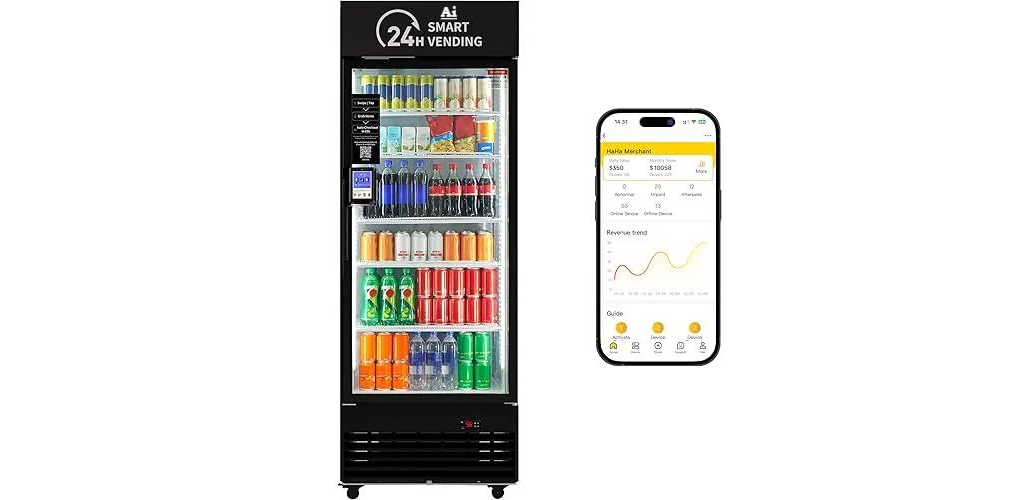
'AI vending machine' has become a much-abused phrase in the Australian market — every operator wants to say they're doing it. When we say it about our fleet, we mean something specific: the machine uses computer vision plus load-cell telemetry to identify each sale in real time, and a demand-forecasting model decides when the machine is restocked and what goes into it. Here's what that actually looks like in an Australian workplace in 2026.
- Step 1
NFC/AI sensors detect the sale
Edge vision confirms the SKU; load cells cross-check by weight.
- Step 2
Telemetry uploads via 4G
Sales, stock and deck temperature stream to the cloud back-office.
- Step 3
Forecast triggers restock alert
Demand-forecast + par-levels flag the machine 24–72 hours ahead of stock-out.
- Step 4
Service visit dispatched
Route-optimised run with a per-machine AI pick-list.
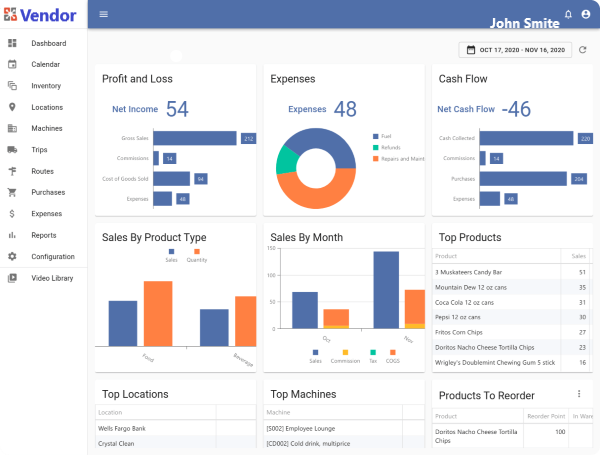
What the 'AI' in an AI vending machine actually does
There are two very different AI workloads inside a modern smart vending machine. The first is on the machine itself — a small vision model that runs on the machine's own control board, watches the shelves through one or two cameras, and confirms every sale by comparing before-and-after images. This is edge AI: fast, private, no cloud round-trip. Its job is accuracy — 'exactly which SKU left the machine?'
The second is in the cloud — a demand-forecasting model that ingests weeks of sales data across every SKU at every site and predicts, per lane, how many units a machine will sell in the next 24, 48 and 72 hours. Its job is planning: 'when does this machine need to be restocked, and with what?' It's the same class of model used by supermarket chains for shelf replenishment, tuned to the smaller scale of a single vending machine.
Camera vision — where the sale is confirmed
In an AI smart fridge, the door opens on tap-authorised access, the staff member takes what they want, and the door closes. The cameras take a still image before the door opens and immediately after it closes. The onboard vision model diffs the two images and returns a SKU and a quantity for that transaction. Weight cells cross-check it. If vision and weight disagree, the machine flags the event for human review rather than guessing.
This is why AI vending machines don't need item-level barcodes or RFID tags — they identify products by shelf position and appearance, so the same shelf can carry different SKUs on different weeks without any reconfiguration.
Demand forecasting — the model that plans restocks
The cloud model takes hourly, daily and weekly sales patterns for each SKU at each site, weather data (which matters more than most people expect for drinks vending in Australia), day-of-week patterns, public holidays, and site-specific events. It outputs a predicted burn rate per lane. That burn rate combined with the current stock level tells the platform when a site is going to run low — usually 24–72 hours ahead of the actual stock-out.
Runs are scheduled against the forecast, not against a fixed calendar. So a site that had a big meeting last Tuesday and a spike in energy-drink sales gets an earlier run this week; a site that's coasting through a quiet period gets a later one. Over three to six months the schedule genuinely converges on what a specific workplace consumes.
SKU mix optimisation — the AI decides what to load
The same forecasting stack also decides what SKUs are worth keeping in each machine. A fast-mover that clears three times a week gets more facings; a slow-mover that hasn't sold in two weeks gets pulled and replaced with a candidate SKU that's been suggested by the model. This is a big departure from the old vending model where the operator picks a national planogram and applies it everywhere — the AI plans a per-site planogram that keeps refining itself.
What this looks like inside an Australian workplace
In a Sydney or Melbourne CBD office, the AI stack is largely invisible to staff. What they notice is that their favourite drink is always in stock, the machine never says 'sold out' on their preferred snack, and the mix in the fridge slowly evolves to include more of what their floor actually eats. In a warehouse or 24/7 site, they notice that fresh food is genuinely fresh — because the model plans smaller, more frequent restocks that keep dates short and turnover high.
AI and food-safety compliance
AI doesn't replace HACCP-style compliance, it strengthens it. Because the platform sees every sale, every temperature reading and every restock event, it can flag anomalies humans miss — an unusually slow-moving SKU that's approaching its use-by, a fridge that's been holding at 4.7 °C when its peer machines in the same suburb are all at 3.1 °C, or a filler whose visits show a consistent gap in the wipe-down checklist. Those signals become work orders.
Cost to the host workplace: still $0
None of this stack is charged back to the host workplace. On the Free Vending Machines Australia program, all restocking, telemetry, cold-chain and AI-driven forecasting is included at $0 to the site. The technology works quietly behind the scenes; the workplace supplies floor space, power and a 4G signal.
Free quote
Request a free AI vending machine
Two-question pre-qualifier — if your site qualifies, an AI-monitored machine is scheduled inside 7–14 business days. $0 to the workplace on eligible sites.
Next article
AI vending machine restocking — how it works in Australian office workplaces across Sydney, Melbourne, Brisbane, Perth and Adelaide
The AI restocking workflow doesn't look the same in every city. Here's how it actually runs in each of Australia's five biggest office markets.
Read next →Related service
Request an AI vending machine
AI-driven restocking, vision-confirmed sales, $0 to the site on eligible workplaces.
See service page →DavidB, VMA
Vending operator & technician
DavidB has 20+ years of hands-on experience across the Australian vending industry. He has configured, installed, removed and transported thousands of machines — from full site rollouts to the quick "pick-up-and-move" jobs that keep a site happy. Starting in repairs, he learned from some of the industry's longest-serving technicians, covering everything from lock changes and fridge decks to vend motors, control boards, coin mechs and note readers. He was also among the earliest installers of Australia's first telemetry systems, helping shape what operators actually need in the back end: product imaging, stock sales, re-ordering, route planning and even catching thieving fillers who did not know the machine was monitored. Later, he moved into supplier roles across note readers, coin acceptors, credit card readers and other cashless acceptance methods including QR code and RFID systems for specialised vending such as PPE machines.