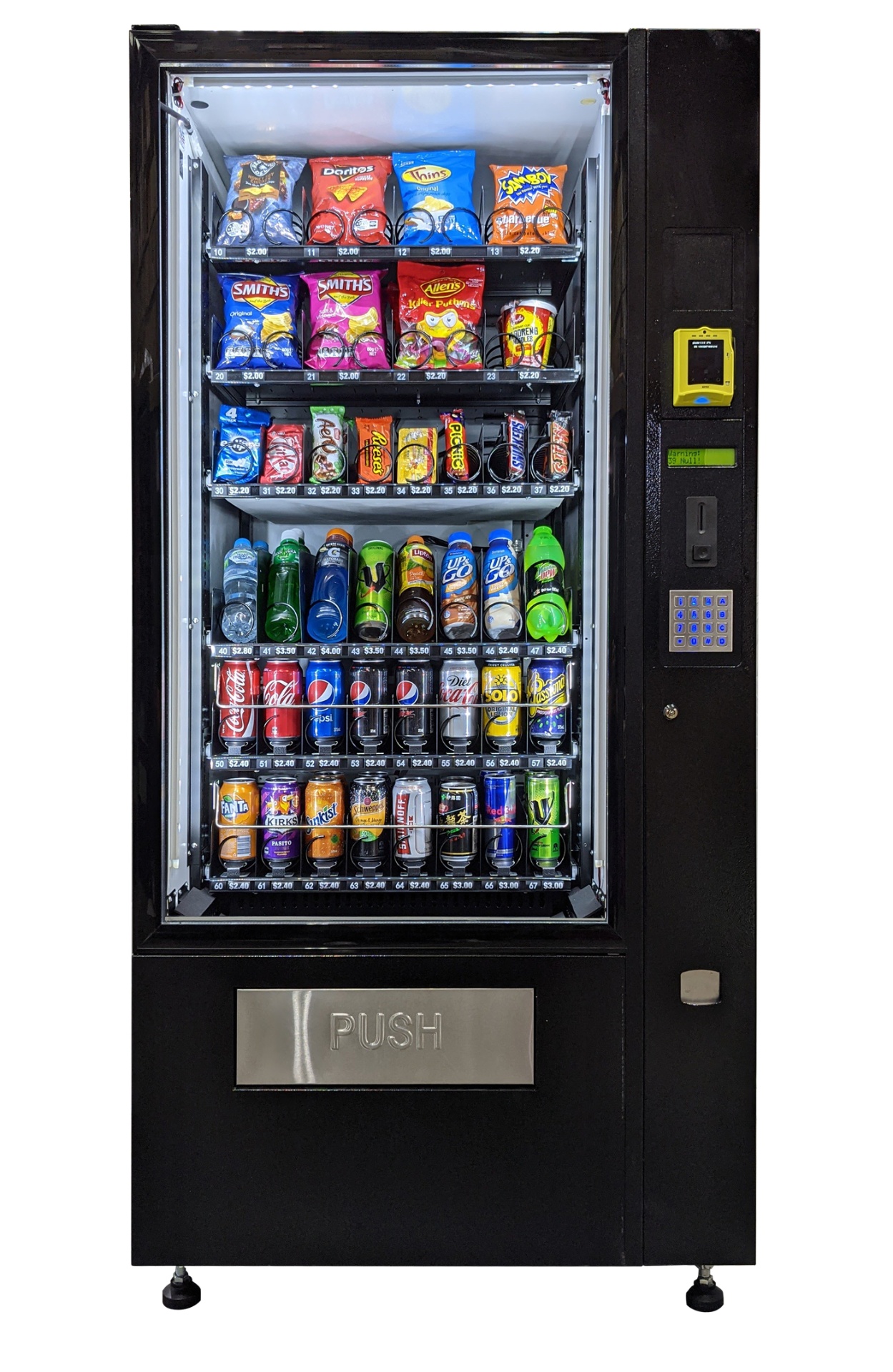
Every Australian workplace that considers a vending machine eventually asks the same question: is it better to take the free placement offer and give up the commission, or is it better to buy or lease the machine and keep the retail margin? The honest answer is 'it depends on your headcount' — but not by nearly as much as most operators will tell you. This guide walks through the real 2026 numbers on both sides, wires them into the on-site earnings calculator, and points you at the four pillar guides that back the maths up.
The three models you're actually comparing
In Australia, there are three legitimate ways to have a vending machine on your site in 2026: free placement (the operator supplies and services the machine at $0, you receive no commission), outright purchase (you own the machine, you buy stock, you handle service — margin is yours), and lease-to-own or operating lease (a monthly payment on the machine plus service, with margin either fully yours or shared). Every 'other' option a supplier pitches is a variation of one of these three. Once you separate the marketing gloss from the paperwork, the comparison becomes tractable.
Free placement — how it really works
Under free placement, an Australian vending operator installs a commercial-grade machine at your workplace, restocks it every one to three weeks, services every mechanical or refrigeration fault, insures it, and removes it if the site changes. The workplace supplies floor space and a standard 240V outlet. Staff pay retail per item at the machine — usually tap-to-pay contactless card, Apple Pay or Google Pay — and every dollar of product margin funds the model. There is no lease, no deposit, no service invoice, no minimum sales guarantee, and no commission to the site.
The eligibility threshold is roughly 25 daily on-site staff, or 200+ daily visitors for public sites. Smaller sites are welcome to enquire — high-traffic reception areas, medical waiting rooms, gyms with 500+ members, remote camps and 24/7 workplaces often qualify with fewer permanent staff because the transaction volume covers the service run.
Outright purchase — the real 2026 numbers
A new commercial vending machine in Australia costs $6,000–$14,000 for a combo unit and up to $18,000 for a smart-fridge or coffee-plus-vending hybrid. On top of the capex, you inherit the running costs the vending operator would have absorbed: stock (roughly 45–55% of retail is cost of goods), route driver labour to restock (typically ~$30/hour), a tap-to-pay card reader (~$20+GST per month rental), merchant fees (~1.5% per sale), public and product liability insurance (~$400/year), refrigeration power, telemetry SIM and software, and refrigeration servicing over the life of the machine (a full compressor recondition alone can run ~$1,500 in parts plus ~$300 labour).
Aggregate that across a 5-year machine life and you're carrying $180–$400 per month of real running cost per machine, on top of the initial capex. Ownership only pays off once the machine turns over enough that the retained margin — after all of the above — clears the imputed cost of your team's own labour. That's the real break-even, and for most Australian workplaces under 100 permanent on-site staff, the free model comes out ahead on a total-cost-of-ownership basis, especially once you cost your time.
Leasing — the middle option
Leasing sits between free and outright purchase. You pay a monthly fee that bundles the machine, service and (sometimes) stock — usually with a 3-year term. The margin either fully accrues to you, or is split with the lessor. Leases work well for two edge cases: 1) a site that wants zero capex but also wants to keep some or all of the margin, or 2) a site that doesn't quite qualify for free placement (under-threshold headcount, low-traffic public location) but still wants a proper commercial unit. The main watch-out is the residual value clause and any early-exit fees; read the contract carefully.
The commission-vs-price-uplift maths
The single most misunderstood part of the comparison is commission. Free placement in Australia is genuinely free because there is no commission paid to the site — that's the trade-off that makes the $0 install sustainable. Sites that push for commission on 'free' machines are usually offered 8–10% of net sales, but the operator then has to lift retail prices toward or above cafe/servo parity to fund it. A can of Coke that's $2.49 in a non-commission machine typically becomes $3.60–$4.00 on a commission site; a chocolate bar moves from about $2.20 to $2.60. Usage drops. Everyone loses a little.
That's why the sharper CEOs skip the commission and ask the operator to run a staff pizza party once or twice a year instead. Same money changes hands, but the site keeps the below-retail non-commission pricing (which drives higher usage and better machine reliability long-term), staff get an actual event they remember, and there's no invoicing overhead. Model both scenarios in the earnings calculator — the numbers are usually closer than a commission-hungry supplier will admit.
When buying (or leasing) actually pays off
Ownership makes sense when four conditions all hold: 1) you have 100+ permanent staff on-site every day, 2) you have someone rostered to restock and clean the machine, 3) you specifically want to keep the retail margin, and 4) you accept the operational overhead of stock forecasting, refrigeration servicing, cashless-reader admin and refrigerant compliance. When all four are true, a purchased or leased machine can throw off enough retained margin to justify itself over 3–5 years. When any of them fails, free placement almost always comes out ahead on total cost of ownership.
Model your own site in under two minutes
The fastest way to answer 'free vs paid, for us' is to run the numbers on the free earnings calculator on this site. It multiplies your on-site headcount by the industry-standard vend rate (0.5 items per person per day for all-day desk/floor staff, 0.15 for transient/rep staff), applies the average price per vend (which changes when commission is requested — because prices lift toward retail parity to fund it), then multiplies by your operating days and commission percentage. It's built on real Australian pricing, the same numbers our route drivers see every week.
Two-minute estimate — free vs commission vs ownership, side by side.
Read the pillar guides behind the maths
Each of the four pillar guides on this site drills into one specific slice of the free-vs-paid decision. Read the pillar that matches your workplace next:
- Free Vending Machines Australia — the complete 2026 guide (the full explainer for the $0 placement model, eligibility, coverage and honest economics).
- Office Vending Machines Australia — free vs buying vs leasing (the office-specific version of the comparison, with staff-count thresholds by ownership model).
- Free Office Coffee Machines Australia — how it works in 2026 (the coffee variant of the free-placement model, with different eligibility thresholds).
- Combination Vending Machines for Australian Warehouses (the combo-unit deep-dive for shift-work sites, with product-mix and rugged-spec detail).
Between the four pillars and the earnings calculator, there's enough independent data to make an evidence-based call on which model fits your workplace — no supplier salesperson required.
Next article
Free vending machines in Australia — the complete guide
How the free placement model actually works in Australia, who qualifies, what it costs (nothing), and where the operator's money really comes from.
Read next →Related service
Model your site in the earnings calculator
Two-minute estimate that models free placement, commission, and ownership side by side on your real headcount and operating days.
See service page →DavidB, VMA
Vending operator & technician
DavidB has 20+ years of hands-on experience across the Australian vending industry. He has configured, installed, removed and transported thousands of machines — from full site rollouts to the quick "pick-up-and-move" jobs that keep a site happy. Starting in repairs, he learned from some of the industry's longest-serving technicians, covering everything from lock changes and fridge decks to vend motors, control boards, coin mechs and note readers. He was also among the earliest installers of Australia's first telemetry systems, helping shape what operators actually need in the back end: product imaging, stock sales, re-ordering, route planning and even catching thieving fillers who did not know the machine was monitored. Later, he moved into supplier roles across note readers, coin acceptors, credit card readers and other cashless acceptance methods including QR code and RFID systems for specialised vending such as PPE machines.