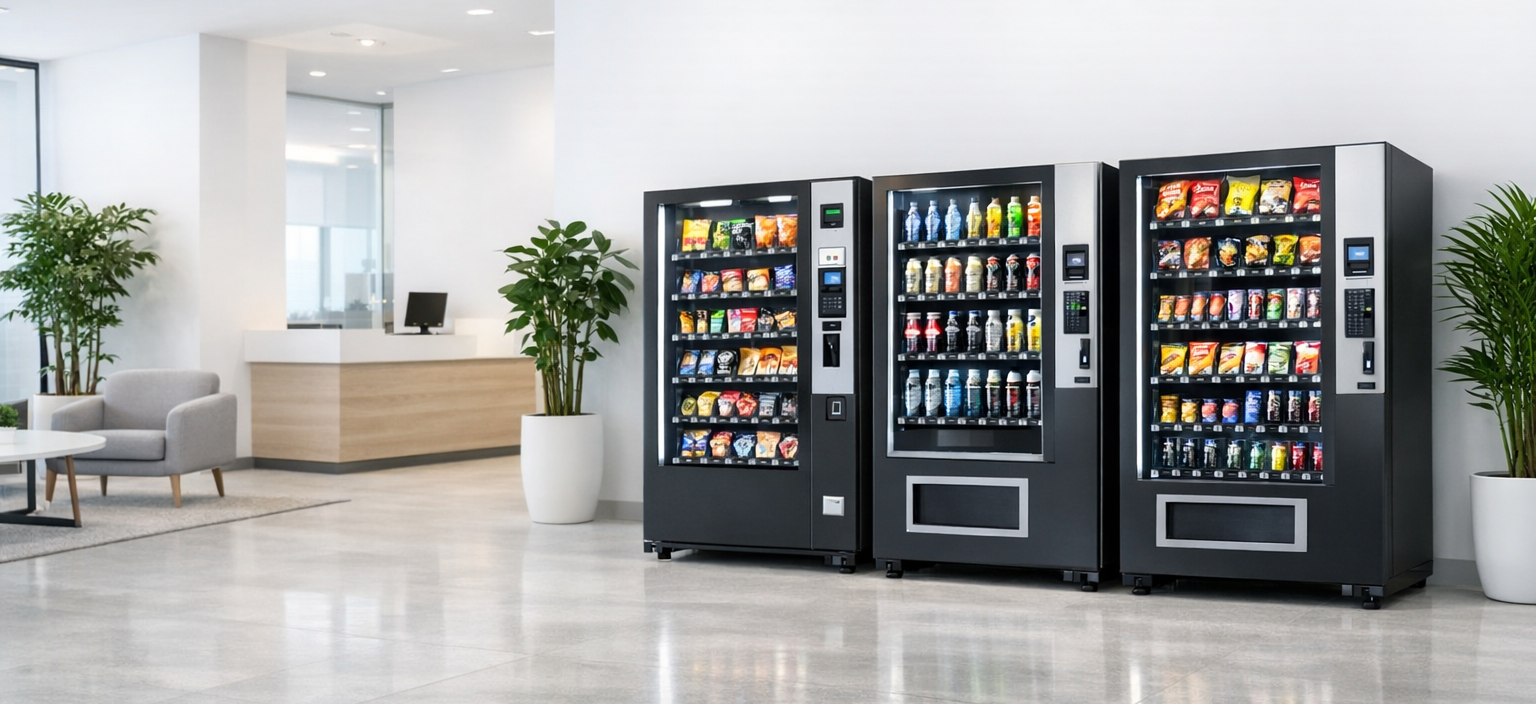
One of the most common questions we get from Australian site managers: 'The lunch room is upstairs — can you still install a vending machine?' The honest answer is yes, almost always, but the day of the install rarely looks like a wheel-in-and-plug-in. A standard combo vending machine weighs 250–300 kg empty. Getting one up a flight of stairs, turned on a tight landing, and squared up in the doorway is genuine physical work for two or three experienced installers.
The stair-climber — what it is and what it can't do
A powered stair-climber is a heavy-duty trolley with a motorised wheel-track that grips each step and lifts the load one riser at a time. It doesn't make a 300 kg machine light — it makes it controllable. Two crew steady the machine top and bottom, a third spots for the landing turn. On a straight run of stairs it's steady work. The pain point is always the landing.
Landings, corners and the doorway problem
Most Australian stairwells were designed for people, not for a fridge on wheels. A 90-degree landing halfway up a flight leaves very little swing room, especially with the trolley behind the machine. On tight jobs we lift the machine off the climber, pivot it by hand on the landing, then re-mount. Doorways are the other choke point — a standard combo machine is usually 650–730 mm deep, and internal office doors are often 720 mm wide. If the frame is skinnier than the machine, the front door comes off before we get near the stairs.
Taking the front door off the machine
It sounds dramatic and it isn't. The front door on most snack and combo machines lifts off its hinges once the top pin is popped. Doing this shaves 25–35 kg off the load, drops the depth by 60–80 mm, and gives the crew somewhere to grip on tight turns. The door travels separately and gets re-hung on site.
When we tell a site it won't work
We do knock jobs back, but rarely for stairs alone. The disqualifiers are usually spiral staircases, narrow walk-up terraces with sharp entries, or heritage buildings with load restrictions on upper floors. If we can't safely land the machine, we say so up front rather than turn up on the day and reverse out of the driveway.
Full breakdown of stair-climbers, doorway prep, and when we say no.
Next article
When stairs aren't an option: hi-ab crane vending machine installs
Sometimes the stairs are out. Sometimes the doorway is out. Sometimes the answer is a truck-mounted crane and a window on the first floor.
Read next →Related service
Upstairs & stair-climb vending installs
Our full service page for first- and second-floor installs — access checks, stair-climber specs, and the edge cases we knock back.
See service page →DavidB, VMA
Vending operator & technician
DavidB has 20+ years of hands-on experience across the Australian vending industry. He has configured, installed, removed and transported thousands of machines — from full site rollouts to the quick "pick-up-and-move" jobs that keep a site happy. Starting in repairs, he learned from some of the industry's longest-serving technicians, covering everything from lock changes and fridge decks to vend motors, control boards, coin mechs and note readers. He was also among the earliest installers of Australia's first telemetry systems, helping shape what operators actually need in the back end: product imaging, stock sales, re-ordering, route planning and even catching thieving fillers who did not know the machine was monitored. Later, he moved into supplier roles across note readers, coin acceptors, credit card readers and other cashless acceptance methods including QR code and RFID systems for specialised vending such as PPE machines.