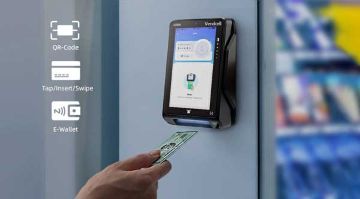
From the customer's side, a contactless vending machine takes about three seconds — tap, beep, product drops. Under the panel, quite a lot happens in those three seconds. Here's the honest technical walk-through of what a contactless vending machine actually does in Australia in 2026, including the two communication protocols (MDB and Pulse 232) that connect the reader to the machine, and the encrypted bank handshake that authorises the vend.
Step 1 — The tap: NFC and the card antenna
The reader on the front of the machine contains a small NFC antenna operating at 13.56 MHz. When a card, phone or wearable is presented within about 4 cm, the reader's magnetic field induces power in the card's passive antenna (a physical card has no battery — the reader energises it). A short EMV conversation begins: the card presents its account identifier, the reader presents the transaction amount, and the card cryptographically signs an authorisation request using its embedded secure element. On a phone or watch, exactly the same conversation happens, except the secure element is a hardware chip inside the device (Apple's Secure Enclave, Google's Titan M, Samsung's Knox).
Step 2 — Reader talks to the machine: MDB and Pulse 232
Once the reader has a signed authorisation, it needs to tell the vending machine to drop the product. That conversation happens over one of two communication protocols, depending on the age and type of machine.
MDB (Multi-Drop Bus) — the modern standard
MDB is the standard on every modern drink, snack, combo, coffee, food, meal, toiletry, cigarette, ice and locker machine sold in Australia. It's a master–slave serial protocol running at 9600 baud on a 24V bus, defined by the NAMA / EVA specifications. The vending machine's control board is the master; the coin mech, note reader, cashless reader and any peripheral (telemetry module, product recogniser) sit on the bus as slaves. When the cashless reader receives an authorised payment, it sends a MDB VEND SUCCESS message on the bus and the control board opens the vend motor for the selected product. If the vend fails (spring stuck, product hung, motor timeout), the machine sends VEND FAILED back and the reader reverses the authorisation before it ever settles — the customer isn't charged. This automatic reversal is one of the practical reasons MDB has stayed dominant.
Pulse 232 — older machines and specialised units
Some older vending machines, older cigarette machines, and a lot of amusement / game / ticket / toy / claw machines still run Pulse 232 (also called Executive Pulse or 232 Pulse — a serial pulse-count protocol). Instead of a structured message bus, the reader emits a fixed number of DC pulses on a serial line to represent 'credit added', and the machine counts pulses to unlock a vend or a game credit. It's a lot simpler but has real limitations: no automatic vend-fail reversal, no product-level reporting, no telemetry-friendly data. When we retrofit a contactless reader onto a Pulse 232 machine, we specify a reader model (Nayax VPOS Touch, Vendcell U2000) that can emulate both MDB and Pulse 232 so the same hardware works on either machine type. Beyond vending, Pulse 232 is what keeps a lot of alcohol dispensers, perfume samplers, cosmetics testers and arcade game cards running with modern tap-to-pay.
Step 3 — Encrypted handshake with the bank
In parallel with talking to the machine, the reader also has to authorise the payment against the card network. It packages the signed authorisation request, encrypts the sensitive card data (PAN, expiry, cryptogram) using 3DES or AES-128, and pushes it over TLS to the payment gateway — typically Nayax's own gateway, Ingenico's Axis, or a Verifone equivalent. The gateway relays to the acquiring bank, the acquiring bank routes to the card scheme (Visa / Mastercard / Amex), the scheme routes to the issuing bank, the issuing bank replies APPROVED or DECLINED, and the message flows back the same way. On 4G in a metro Australian workplace this round trip runs 1.5–2.5 seconds. On Wi-Fi with a strong signal it's often under a second.
Critically, the card data itself never sits unencrypted in the vending machine or on the reader's disk. This is what lets a vending operator run thousands of machines across the country without holding a full PCI-DSS Level 1 certification on every site — the encryption endpoints live in the reader hardware and the gateway, not in the machine control board.
Step 4 — Telemetry and reporting
Every successful (and failed) vend also becomes a telemetry event. The reader forwards the transaction to the operator's back office (Nayax, Cantaloupe, Televend) which builds the near-real-time picture: which slots are running low, which machines are offline, which readers have failed to connect, which sites are trending up in volume. Restocking runs are planned off this data, not off a fixed calendar. Faults get diagnosed remotely before the site notices — a coin mech jam, a reader offline, a compressor over-temperature all raise alerts within minutes.
Which machines run this stack in Australia?
All new-model vending machines sold in Australia in 2026 — drink, snack, combo, coffee, food, meals, toiletries, cigarette, ice, lockers, plus custom builds like perfume, cosmetics, alcohol, game card and toy machines — use the same underlying payment stack described above. MDB is the default on drink / snack / combo / coffee / food / meal / toiletry / cigarette / ice / locker units. Pulse 232 remains common on game and amusement machines, some older cigarette units, and specialised custom vending. Modern readers speak both, so a contactless upgrade is possible on almost any deployed unit that still has power and a functional control board.
How to get one installed
On the Free Vending Machines Australia program, we ship every new machine with a Nayax or Vendcell reader pre-configured over MDB (or Pulse 232 where the machine requires it), pre-activated on 4G telemetry, and ready to accept a tap on install day. Cost to the workplace: $0. If you want to retrofit an existing coin-op machine, we also do standalone reader installs at cost — most sites, however, prefer a full free-machine swap because the newer hardware is meaningfully faster and more reliable than a 10-year-old coin-op panel.
Free quote
Request a free contactless vending machine quote
Get a written quote for a fully contactless machine — MDB or Pulse 232 configured on install day, 4G telemetry live from hour one, tap-to-pay ready. Zero cost to eligible workplaces.
Next article
5 reasons to switch to a contactless vending machine
The five reasons Australian sites are ditching coin-op machines in 2026 — and how the upgrade costs the workplace $0.
Read next →Related service
Book a contactless machine
MDB or Pulse 232 configured on install day, tap-to-pay ready, $0 to the workplace.
See service page →DavidB, VMA
Vending operator & technician
DavidB has 20+ years of hands-on experience across the Australian vending industry. He has configured, installed, removed and transported thousands of machines — from full site rollouts to the quick "pick-up-and-move" jobs that keep a site happy. Starting in repairs, he learned from some of the industry's longest-serving technicians, covering everything from lock changes and fridge decks to vend motors, control boards, coin mechs and note readers. He was also among the earliest installers of Australia's first telemetry systems, helping shape what operators actually need in the back end: product imaging, stock sales, re-ordering, route planning and even catching thieving fillers who did not know the machine was monitored. Later, he moved into supplier roles across note readers, coin acceptors, credit card readers and other cashless acceptance methods including QR code and RFID systems for specialised vending such as PPE machines.